
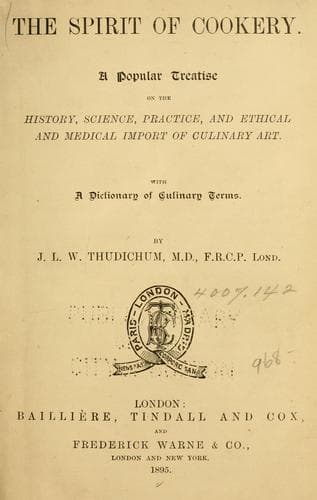
The spirit of cookery
1895Johann Ludwig Wilhelm Thudichum · 457 readable pages · 303 recipe records · comprehensive scientific household and professional cookbook
From the librarian's dossier · AI-generated, grounded in the scanned text
The Spirit of Cookery (1895) is a monumental Victorian culinary treatise by Johann Ludwig Wilhelm Thudichum, a physician and chemist who set out to place cookery on a scientific and historical foundation rather than leaving it to unexamined tradition. The book opens with a philosophical and historical survey of cookery from antiquity to the nineteenth century before moving into an encyclopedic treatment of kitchen practice: stocks and consommes, soups classified by ingredient, the grand sauces and their derivatives, meats, game, fish and shellfish, vegetables, breads, pastries, puddings, cakes, ices, eggs and dairy, beverages, formal dining structure, and even camp cookery for soldiers in the field. A closing alphabetical glossary defines hundreds of French and English culinary terms. Throughout, Thudichum blends recipes with chemistry, physiology, and etymology, frequently correcting what he considers errors and myths in earlier cookery writing, such as the belief that bones contribute flavor to broth. Modern readers will find a work that is as much a work of culinary history and food science argument as it is a recipe collection, reflecting the ambitions of late Victorian household and professional cookery literature to be authoritative, rational, and international in scope.
The book is organized into numbered chapters that move from theory to practice. Sections 1 through 7 lay out the history and philosophy of cookery, kitchen equipment, and general culinary processes such as boiling, baking, roasting, and frying. Sections 8 through 15 cover spices, meat extracts and broths, and the full classification of soups, including invalid diets, bisques, and international stews like puchero and pilau. Sections 16 through 20 treat sauces systematically, from the five grand sauces through their many derivatives, followed by jellies, fats, frying, and forcemeats. Sections 21 through 27 address vegetables, salads, pastes, breads, dumplings, and an extensive survey of cakes and pastries. Sections 28 through 37 form a long sequence on butcher's meat, poultry, game, and fish, organized by animal and cut, followed by pies and molded dishes. Sections 38 through 40 cover eggs, dairy, frozen desserts, and beverages including wines, spirits, and punches. Sections 41 and 42 discuss the philosophy and structure of formal dinners and camp cookery for soldiers. The book closes in sections 43 through 45 with an alphabetical glossary of culinary terms and a concluding index.
Recipes from this book
303 records extracted from the text, showing the first 50 in reading order. Each links to a modern interpretation.
Read the book
457 readable pages. A dot marks pages with recipe records.