
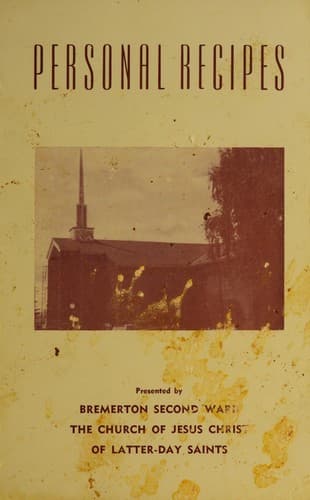
Personal recipes
1960Iona McConkie · 20 readable pages · 116 recipe records · community and church-affiliated household cookbook
From the librarian's dossier · AI-generated, grounded in the scanned text
Personal Recipes is a 1960 community cookbook compiled by Iona McConkie for the Bremerton Second Ward of the Church of Jesus Christ of Latter-day Saints. Like many mid-century church and club cookbooks, it gathers recipes contributed by members of the congregation into a single practical volume meant for everyday family cooking. The book opens with a dedication and an expression of appreciation that frame the collection as a celebration of home cooking and family meals, followed by a lighthearted piece titled How to Preserve a Husband. From there it moves into a wide range of categories: relishes and pickles, soups and salads, meat substitutes, vegetables, casseroles, meat and poultry, breads, cakes, cookies, desserts, and preserves. The recipes mix traditional scratch cooking with the era's convenience-oriented approach, incorporating canned goods and processed ingredients alongside homemade pickles, breads, and candies. Brand names such as Darigold appear throughout, anchoring the book firmly in its postwar American grocery context. With 116 anchored food records across its two sections, this is a substantial, if modest, community-authored collection. It offers modern readers a window into how one Pacific Northwest Latter-day Saint ward cooked, entertained, and shared food in 1960.
The cookbook is organized into two mechanically gated sections that together move through a broad sweep of home-cooking categories. Section 1 covers the front matter, including the dedication, an expression of appreciation, and the humorous How to Preserve a Husband piece, followed by weights and measures conversions, cooking terms, handy kitchen hints, and roasting time charts. It then presents relishes, pickles, and appetizers, followed by soups, salads, and beverages, and continues into meat substitutes, vegetables, casseroles, and meat and poultry dishes. Section 2 continues with breads, cakes, cookies, desserts, and a jelly, preserve, and candy section. Headings suggest the book is arranged as a fairly conventional recipe-category cookbook rather than an alphabetical dictionary, with contributor-submitted recipes grouped by course or type.
Recipes from this book
116 records extracted from the text, showing the first 50 in reading order. Each links to a modern interpretation.
Read the book
20 readable pages. A dot marks pages with recipe records.