
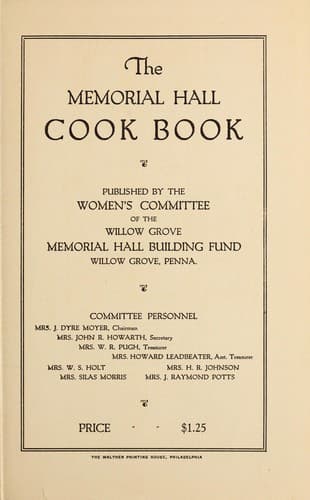
The Memorial Hall cook book
1919Willow Grove Memorial Hall (Willow Grove, Pa.) · 64 readable pages · 367 recipe records · community cookbook
From the librarian's dossier · AI-generated, grounded in the scanned text
The Memorial Hall Cook Book is a 1919 community cookbook compiled by the Willow Grove Memorial Hall in Willow Grove, Pennsylvania. Like many charitable and civic cookbooks of its era, it gathers recipes contributed by local residents into a single practical volume, likely produced to raise funds or support the Memorial Hall itself. The book moves through the full range of early twentieth-century American home cooking, covering eggs, fish, soups, poultry, meats, vegetables, salads, pies, puddings, cakes, cookies, breads, pickles, preserves, and candies. Interspersed among the recipes are advertisements from local Willow Grove businesses, along with a table of contents and acknowledgments to contributors, which mark this as a genuine community artifact rather than a commercially authored text. With 367 anchored food records, the book offers a dense, practical record of what a Pennsylvania community considered good everyday and special-occasion cooking in the years just after the First World War. Readers will find an emphasis on thrift, resourceful use of stock and leftovers, and reliance on then-common brand products like Rumford baking powder and Knox gelatin. The overall effect is less a polished culinary treatise and more a snapshot of shared domestic knowledge, assembled recipe by recipe from many hands, reflecting both the tastes and the social fabric of a small American town in 1919.
The cookbook is organized by food category, following a sequence typical of household cookbooks of its period: eggs, fish, and seafood; soups; poultry; meats; vegetables and potatoes; salads and dressings; pastry, pies, puddings, and other sweets; cakes, cookies, gems, and breads; crullers, doughnuts, and griddle cakes; butters, jams, jellies, and pickles; candies; and a closing miscellany of additional cakes, sandwiches, and unclassified dishes. The final pages contain a full table of contents, acknowledgments to contributors and local businesses, and advertisements, confirming the book's identity as a community-assembled volume. Recipes are generally grouped under clear category headings, with named contributors attached to many entries, especially in the cake, cookie, and bread sections.
Recipes from this book
367 records extracted from the text, showing the first 50 in reading order. Each links to a modern interpretation.
Read the book
64 readable pages. A dot marks pages with recipe records.