
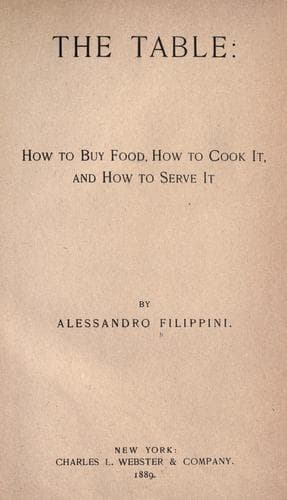
The table
1889Alexander Filippini · 358 readable pages · 1,038 recipe records · general household and professional cookbook with integrated menu planner
From the librarian's dossier · AI-generated, grounded in the scanned text
The Table (1889) by Alexander Filippini is a monumental American cookbook combining a working recipe encyclopedia with an elaborate menu-planning system for upscale households, hotels, and restaurants of the Gilded Age. Opening with essays on New York markets and detailed seasonal guides to fish, game, and vegetables, the book quickly moves into an extraordinary week-by-week calendar of breakfast, luncheon, and dinner menus running across an entire year, each dish cross-referenced by number to fuller recipes later in the volume. The bulk of the book that follows is organized as a classical French-influenced culinary reference, covering soups, stocks, sauces, forcemeats, fish, eggs, meats, poultry, game, vegetables, salads, and an extensive dessert section spanning pastries, puddings, ices, and preserves. The book closes with banquet menus from state dinners and royal celebrations, descriptions of foreign dining customs, and a detailed alphabetical index. With over a thousand anchored food records, this is less a simple recipe collection than a professional culinary manual documenting how affluent Americans of the late nineteenth century planned, prepared, and served elaborate meals throughout the year.
The book opens with introductory essays on markets, meat quality, and seasonal guides to fish, vegetables, and melons (sections 1-2), followed by an extended calendar of daily menus organized by week and month from January through December, each entry keyed by recipe number (sections 2-9). This menu calendar gives way to the recipe body proper, arranged by category: soups (sections 10-11), stocks, sauces, forcemeats, and garnishings (sections 11-13), hors d'oeuvres and fish (sections 14-16), eggs (sections 16-17), beef, veal, mutton, lamb, and pork (sections 17-21), poultry and game (sections 21-23), vegetables (sections 24-26), salads (section 26), and an extended desserts section covering pastry, puddings, rice dishes, cakes, frozen desserts, jellies, preserves, and coffee and tea preparations (sections 26-33). The book concludes with banquet menus from royal and state occasions, descriptions of foreign dining customs, and a comprehensive alphabetical index (sections 35-36).
Recipes from this book
1,038 records extracted from the text, showing the first 50 in reading order. Each links to a modern interpretation.
Read the book
358 readable pages. A dot marks pages with recipe records.