
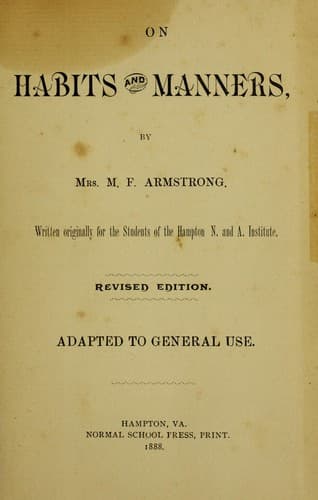
On habits and manners
1888M. F. Armstrong · 92 readable pages · 53 recipe records · conduct and domestic household manual with appended cookery and agricultural advice
From the librarian's dossier · AI-generated, grounded in the scanned text
On Habits and Manners is an 1888 conduct manual by M. F. Armstrong, written for students at Hampton Institute and later revised for wider use. It is primarily a guidebook to personal deportment, covering table etiquette, hygiene, dress, courtship, correspondence, and moral character, before broadening into domestic economy: home ownership, house construction, sanitation, housework, child-rearing, care of the sick, and finally a small cluster of household recipes and advice for beginning farmers. The book blends etiquette instruction with practical household management, reflecting its origin as a training text meant to prepare young men and women for respectable, self-sufficient adult life. Readers will find detailed instructions on posture at table, bathing and grooming, appropriate clothing, letter-writing conventions, and behavior while traveling, alongside chapters on building a home, raising children with moral consistency rather than corporal punishment, and running an orderly household. The recipes and farming advice near the end are brief and secondary to the book's main purpose as a manners and life-skills manual. Modern readers will encounter frank period attitudes about race, gender roles, and class alongside genuinely detailed domestic and hygienic instruction, making this a valuable but dated window into ideals of respectability and self-improvement taught to Hampton Institute's students in the late nineteenth century.
The book proceeds as a sequence of numbered chapters moving from personal etiquette (table manners, hygiene, dress) through social conduct (general society, travel, letter writing) to moral and domestic instruction (minor morals, house and home, building, woman's work, moral training of children, housework, care of the sick), concluding with a short block of cooking recipes and a chapter of agricultural advice for beginning farmers. Each section summary corresponds to roughly ten pages of continuous chapters, with headings marking chapter and sub-chapter breaks such as CHAPTER I through CHAPTER XXI and beyond.
Recipes from this book
53 records extracted from the text, showing the first 50 in reading order. Each links to a modern interpretation.
Read the book
92 readable pages. A dot marks pages with recipe records.