
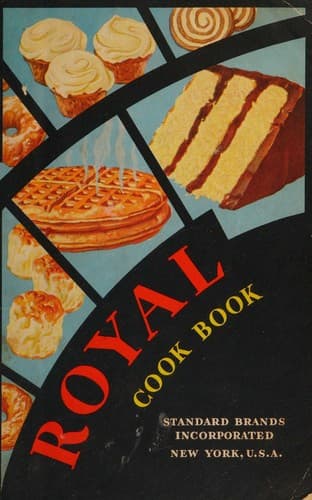
Royal cook book
1930Standard Brands Incorporated · 46 readable pages · 273 recipe records · general household cookbook with advertising content
From the librarian's dossier · AI-generated, grounded in the scanned text
The Royal Cook Book is a 1930 promotional cookbook issued by Standard Brands Incorporated, makers of Royal Baking Powder. Part advertisement and part practical kitchen manual, it blends technical instruction on baking chemistry with a broad range of household recipes typical of the era. Readers are introduced to the science and marketing behind cream of tartar baking powder before moving into recipes covering baked goods, puddings, pies, beverages, meats, poultry, eggs, sauces, salads, and preserves. The book positions Royal Baking Powder as essential to reliable home baking, citing endorsements from domestic science teachers, home economics directors, and dietitians to lend authority to its claims. With 273 anchored food records, it functions as a fairly comprehensive general cookbook of the period, even as its origins as a corporate promotional product remain evident throughout. Modern readers will find it a useful window into 1930s home cooking practices, ingredient availability, and the era's trust in branded, standardized products as guarantors of culinary success. It is best approached as both a cooking reference and a historical advertising artifact, revealing how food companies shaped domestic cooking guidance during this period.
The book opens with foundational material on baking technique, measurement, and ingredient science before moving into recipe sections. Section 1 covers measuring methods, oven temperatures, and the properties of Royal Baking Powder's ingredients, alongside early recipes for biscuits, tea breads, and coffee cakes. Section 4 groups puddings, pie crusts and pie varieties, beverages, sandwiches, fish, and meats, with a heading cluster suggesting a further subsection on shortcakes. Section 5 concludes with poultry, eggs, sauces, luncheon dishes, salads, and preserves. The organization follows a typical household cookbook progression from baked goods through main courses to preserved foods, with recipe categories introduced by descriptive headings rather than strict alphabetical order.
Recipes from this book
273 records extracted from the text, showing the first 50 in reading order. Each links to a modern interpretation.
Read the book
46 readable pages. A dot marks pages with recipe records.