
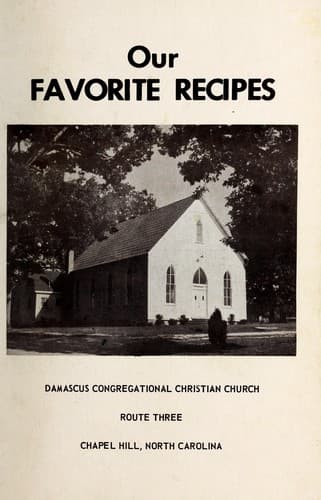
Our favorite recipes (Damascus Church, Chapel Hill, 1963)
1963Damascus Congregational Christian Church (Chapel Hill, N.C.) · 24 readable pages · 116 recipe records · community church cookbook
From the librarian's dossier · AI-generated, grounded in the scanned text
This 1963 community cookbook was compiled by the Women's Fellowship of Damascus Congregational Christian Church in Chapel Hill, North Carolina, a congregation whose history the book traces from its 1789 founding through the year of publication. Like many church and club cookbooks of its era, it blends local history with practical kitchen knowledge, opening with an account of the church's ministers and congregational life before moving into recipes contributed by its members. The collection reflects the everyday cooking of a mid-twentieth-century Southern American household and church community, featuring soups, casseroles, main dishes, breads, cakes, pies, cookies, candies, pickles, and preserves. It also includes practical reference material for cooks, such as calorie counts, kitchen measures, canning tables, and quantity-cooking guides for feeding large groups at picnics or church gatherings. With 116 anchored food records, the book is substantial for a small-press community cookbook. Modern readers will find it a useful window into congregational life, home economics, and Southern comfort food of the early 1960s, written in the plain, instructional voice typical of church fundraising cookbooks rather than a professionally edited culinary text.
The book is organized into three broad sections. Section 1 opens with the church's history and list of ministers from 1794 to 1963, then transitions into everyday recipes: soups, salads, casseroles, main dishes, breads, and cakes. Section 2 is dominated by desserts and special-occasion food, including cakes, pies, cookies, candies, beverages, and preserving recipes such as pickles, along with quantity-serving guides for picnics of 25, 50, and 100 people and a calorie counter. Section 3 functions as a kitchen reference appendix, covering calorie counts, baking instructions, kitchen measurements and conversions, roasting times, canning time tables, and candy-making temperature tests. The overall structure moves from congregational history to daily recipes to celebratory and preservation recipes to practical reference tables.
Recipes from this book
116 records extracted from the text, showing the first 50 in reading order. Each links to a modern interpretation.
Read the book
24 readable pages. A dot marks pages with recipe records.