
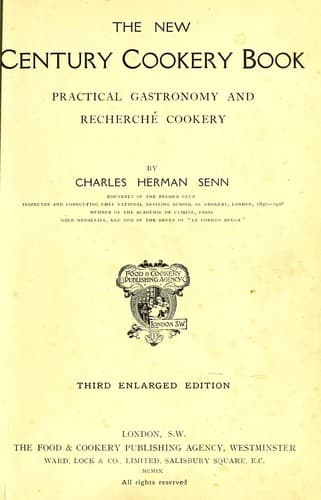
The new century cookery book
1901Charles Herman Senn · 602 readable pages · 1,417 recipe records · professional and household culinary reference (French-influenced haute cuisine cookbook)
From the librarian's dossier · AI-generated, grounded in the scanned text
The New Century Cookery Book (1901) is Charles Herman Senn's expansive revision and expansion of his earlier work, 'Practical Gastronomy,' aimed at both professional chefs and household cooks. Senn, drawing on an extensive career and contributions from leading European and American chefs, sets out to combine practical culinary instruction with the scientific understanding of food then current, discussing proteins, fats, and carbohydrates alongside cooking method. The book moves from foundational material on choosing ingredients, kitchen design, and cooking techniques into an enormous run of recipes organized by course and category: soups, sauces, fish, hors d'oeuvre, hot and cold meat entrees, poultry, game, vegetables, farinaceous dishes, salads, sweets, ices, savouries, eggs, cheese, and pastries. It closes with chapters on menu composition, table service, wine service, a glossary of French culinary terms, and an index. The recipes are heavily French in character and vocabulary, reflecting the haute cuisine standards of Edwardian formal dining, though the book also addresses everyday household economy. Modern readers will find it a detailed record of turn-of-the-century professional and upper-household cookery, offering both technical instruction and a window into the elaborate dining conventions, kitchen organization, and culinary science of its era.
The book opens with front matter and an introduction to the science of cookery (section 1), then proceeds through chapters on choosing food, kitchens, cooking methods, stocks, soups, and sauces (sections 2 to 7). A chapter of weights, measures, and technical preparations (section 8) precedes an extended run of hors d'oeuvre and soup recipes (sections 9 to 13). Sauces, garnishes, and forcemeats occupy sections 15 and 16. The bulk of the middle chapters (sections 18 to 35) is organized by course and protein: fish, then hot meat entrees (lamb, mutton, beef, veal, poultry, game), then cold service dishes including galantines, pates, and aspic work. Roasting, braising, and carving are addressed in section 37, followed by an extensive vegetable chapter (sections 37 to 41), farinaceous dishes and salads (sections 42 to 43), and a long sequence of sweet entremets, puddings, creams, jellies, cakes, and frozen desserts (sections 43 to 49). Savouries, breakfast dishes, eggs, and cheese preparations follow (sections 50 to 52), with pastries and biscuits in section 54. The book concludes with chapters on menu composition and specimen menus (sections 55 to 57), table and wine service, a gastronomic epitome, a glossary of cookery terms (section 58), and an alphabetical index with advertisements for the author's other works (sections 60 to 61).
Recipes from this book
1,417 records extracted from the text, showing the first 50 in reading order. Each links to a modern interpretation.
Read the book
602 readable pages. A dot marks pages with recipe records.