
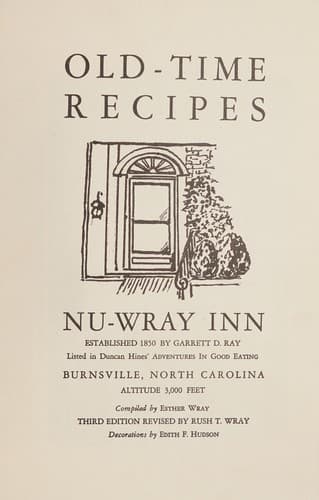
Old-time recipes
1947Esther Wray · 10 readable pages · 52 recipe records · regional inn cookbook with narrative heritage content
From the librarian's dossier · AI-generated, grounded in the scanned text
Old-time Recipes (1947) is a house cookbook from the Nu-Wray Inn in Burnsville, North Carolina, compiled by Esther Wray. It gathers the inn's traditional Southern and Appalachian mountain recipes alongside passages describing the inn's history, its furnishings, and the surrounding western North Carolina landscape. Readers will find dishes central to home cooking of the era: fried chicken with cream gravy, biscuits, cured ham, liver mush, souse meat, preserves, relishes, pickled vegetables, pies, cakes, and festive beverages like eggnog and syllabub. The book blends practical instruction with nostalgic, promotional writing meant to celebrate the inn as an institution as much as to teach cooking. It reflects domestic techniques common in the late nineteenth and early twentieth centuries, including home preservation and cast iron cookery. This is less a systematic culinary manual than a keepsake volume, mixing recipe content with local color and literary flourishes about the inn's heritage. Modern readers interested in Southern foodways, regional inn culture, and mid-century American cookbook publishing will find it a useful primary source, though it should be read as a period artifact rather than a modern kitchen reference.
The book is organized as a single continuous section blending narrative and recipes rather than strict categorical chapters. It opens with a foreword and table of contents, then moves through descriptive material about the inn (such as 'The Blue Room') interspersed with recipe headings like 'Liver Mush,' 'Souse Meat,' and 'How to Fry Nu-Wray Ham.' Recipes for beverages, pies, cakes, preserves, and pickled vegetables appear alongside this narrative content, suggesting the cookbook is arranged more as a themed keepsake than a rigidly indexed reference.
Recipes from this book
52 records extracted from the text, showing the first 50 in reading order. Each links to a modern interpretation.
Read the book
10 readable pages. A dot marks pages with recipe records.