
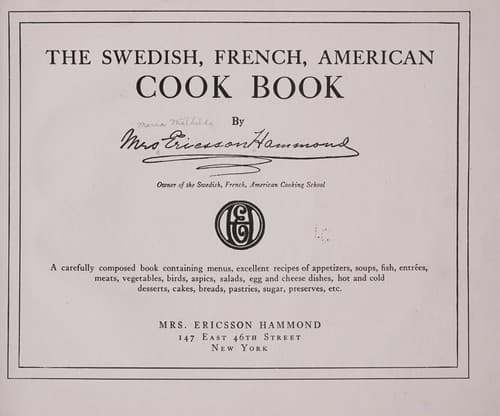
The Swedish, French, American cook book
1918Hammond, Maria Mathilda (Ericsson) Mrs. · 682 readable pages · 2,454 recipe records · general household and formal-dining cookbook with alphabetical index
From the librarian's dossier · AI-generated, grounded in the scanned text
The Swedish, French, American Cook Book (1918) by Maria Mathilda (Ericsson) Hammond is a massive, encyclopedic culinary work that fuses haute French technique with Swedish and American home cooking traditions. Organized around a professional cooking school class, the book moves through an enormous range of categories, from elaborate hors d'oeuvres and consommes through nearly every fish, shellfish, meat, and game bird imaginable, then on to eggs, cheese, vegetables, salads, sauces, frozen desserts, puddings, pies, cakes, breads, preserves, and confectionery. Many recipes are named after individuals, real or honorary (a la Hammond, a la Ericsson Hammond, a la Walde), suggesting a personalized, almost dedicatory approach to recipe naming throughout. The book demonstrates the ornate presentation standards of Gilded Age and early twentieth-century formal dining, with heavy use of aspic, mousse, chaud-froid, and gelatine work, alongside more everyday American baking and preserving instructions. It closes with extensive reception menus and a lengthy alphabetical index. This is a book for the ambitious or professional cook, reflecting a period when multi-course formal service, decorative plating, and named signature dishes were markers of culinary sophistication. Modern readers will find it a rich window into the era's elaborate entertaining culture as much as a working recipe collection.
The book opens with contents, a note on the author's cooking school class, and a preface (section 1), then proceeds through a long sequence of food categories: appetizers and hors d'oeuvres, sandwiches, soups and consommes, an extensive run of fish species treated one by one (halibut, salmon, shad, striped bass, mackerel, flounder, turbot, pompano, trout, smelt, codfish, eel, carp, and more), shellfish (lobster, shrimp, crab, oysters, clams, mussels, terrapin, turtle, frog legs), then meats in turn (beef, veal, sweetbreads and organ meats, lamb and mutton, pork and ham, tongue), poultry and game (chicken, turkey, duck, goose, pigeon and squab, wild duck, pheasant, partridge, quail, woodcock, snipe, grouse, ortolans, plovers, venison, rabbit), eggs, cheese dishes, vegetables (organized vegetable by vegetable), salads, sauces, frozen desserts, fruit-based desserts, puddings, pies, cakes, small cakes and cookies, breads and breakfast items, preserves and pickles, and confectionery. The book concludes with reception menus for various meals and an extensive alphabetical index (sections 65 through 69) covering the entire contents. Recipes within each category are typically arranged from simple to elaborate, hot dishes before cold, and often include both French and English titles.
Recipes from this book
2,454 records extracted from the text, showing the first 50 in reading order. Each links to a modern interpretation.
Read the book
682 readable pages. A dot marks pages with recipe records.