
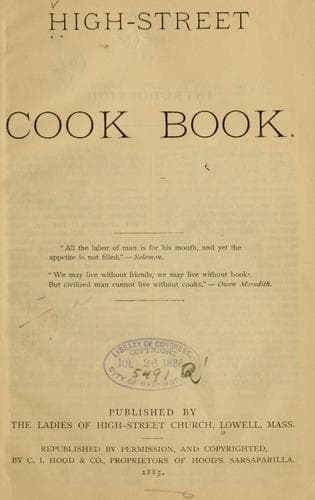
High-Street cook book
1885C.I. Hood & Co. (Lowell, Mass.), Katherine Golden Bitting Collection on Gastronomy (Library of Congress) · 39 readable pages · 122 recipe records · promotional household cookbook (patent medicine advertising cookbook)
From the librarian's dossier · AI-generated, grounded in the scanned text
The High-Street Cook Book (1885) is a promotional pamphlet cookbook issued by C.I. Hood & Co. of Lowell, Massachusetts, the makers of Hood's Sarsaparilla. Behind its modest size lies a hybrid document: a working household recipe collection interleaved with advertising testimonials for a patent medicine. Readers will find over a hundred recipes spanning meats, fish, vegetables, salads, cakes, puddings, jellies, candies, and food preservation methods, arranged alongside letters from satisfied customers praising Hood's Sarsaparilla for curing ailments from scrofula to dyspepsia. This juxtaposition, recipes and remedies sharing the same pages, was a common commercial strategy of the era, using useful household content to keep a branded booklet in the kitchen. The book closes with sample dinner menus for families of varying sizes, practical preservation techniques for beef and bacon, and a table of contents, alongside further promotion of Hood's Tooth Powder, Olive Ointment, and Vegetable Pills. For the modern reader, this is less a polished culinary text than a artifact of nineteenth-century domestic advertising, offering a window into how commercial patent medicine companies embedded themselves into everyday kitchen life through free recipe booklets distributed to households and pharmacies alike.
The book is organized into three mechanically identified sections covering pages 10 through 38 (the surviving portion of the text). Section 2 opens with fish, vegetable, salad, and omelet recipes alongside meat dishes, interspersed with sarsaparilla testimonials. Section 3 moves into cakes, cookies, fancy desserts, jellies, and pudding sauces, again broken up by advertising content. Section 4 concludes with candy recipes, food preservation techniques (pickling, brining), sample dinner menus for families, a table of contents, and heavy promotional material for Hood's product line. Headings such as FISH, VEGETABLES, SALADS, PICKLES, CANDY, and MISCELLANEOUS suggest a loosely categorical rather than strictly alphabetical organization, with advertising content woven throughout rather than segregated.
Recipes from this book
122 records extracted from the text, showing the first 50 in reading order. Each links to a modern interpretation.
Read the book
39 readable pages. A dot marks pages with recipe records.