
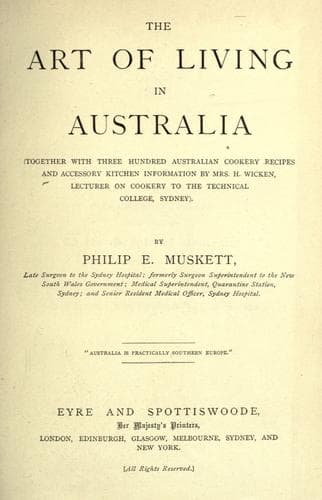
The art of living in Australia
1893Philip E. Muskett · 247 readable pages · 311 recipe records · household health and cookery manual
From the librarian's dossier · AI-generated, grounded in the scanned text
The Art of Living in Australia (1893) is Philip E. Muskett's ambitious attempt to reform how Australians eat, dress, and care for their bodies to suit a semi-tropical climate. Part health polemic and part cookbook, it argues that colonial Australians ate too much meat and drank too much tea while neglecting fish, vegetables, salads, and wine, habits Muskett considered mismatched to the country's climate. The book opens with wide-ranging discussions of climate, physiology, ventilation, clothing, exercise, and education before turning to detailed advocacy for Australian fisheries and viticulture, and finally settles into Part II, a substantial practical cookery section with recipes for soups, fish, meat, vegetables, sauces, salads, and puddings. Throughout, Muskett writes as a physician-reformer, citing medical authorities and comparing Australian practices unfavorably to European and English models. The recipes are practical and costed for household economy, reflecting genuine concern for working-class and middle-class Australian kitchens. Modern readers will find this a fascinating hybrid document, part domestic science manual, part nationalist dietary manifesto, part everyday cookbook, that captures anxieties and aspirations of colonial Australian society at the end of the nineteenth century. It rewards readers interested in the history of food reform, climate theory, and Australian material culture as much as those seeking historical recipes.
The book is organized in two broad parts. Part I (sections 1 through 17) is discursive and reformist, covering climate science, personal hygiene (ventilation, clothing, skin physiology), diet and beverages (fruit, tea, coffee, iced drinks, tobacco), exercise, education and school cookery, Australian food habits, fish and fisheries, salads and salad herbs, and an extended treatise on Australian wine and viticulture spanning several chapters (climate, soil, grape varieties, cellar management, fermentation, tasting, and industry prospects). Part II (beginning in section 17 and running through section 24) is the practical cookery portion, organized by chapter into kitchen equipment, the stock pot, soup (fifty recipes), fish, meat, vegetables (fifty recipes), salads and sauces (fifty recipes), and sweets, pastries, and baked goods. Section 25 is a detailed alphabetical index covering the entire volume, followed by publisher advertisements.
Recipes from this book
311 records extracted from the text, showing the first 50 in reading order. Each links to a modern interpretation.
Read the book
247 readable pages. A dot marks pages with recipe records.