
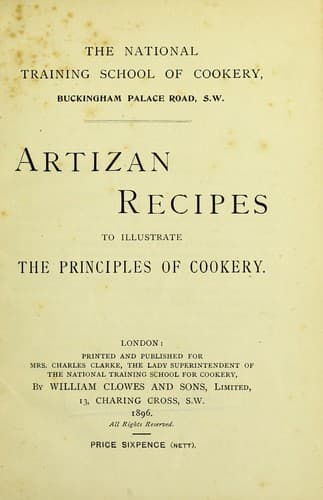
Artizan recipes
1896Clarke, Charles Mrs · 92 readable pages · 440 recipe records · instructional household and teacher-training cookbook
From the librarian's dossier · AI-generated, grounded in the scanned text
Artizan Recipes (1896) by Mrs. Charles Clarke is a late-Victorian instructional cookbook built around teaching, not merely eating. Its roughly 440 anchored food entries move through stocks, soups, meats, fish, vegetables, breads, cakes, pastries, puddings, sauces, egg dishes, and sick-room preparations, following the structure of a cookery course rather than a household reference. The recipes are written in a terse, stripped-down style, listing ingredients and brief steps without much explanatory prose, because the book's stated purpose is to train aspiring cookery teachers and, eventually, schoolchildren, in sound technique they can then pass on to others. Interwoven with the recipes are lesson plans, scullery-work instructions for cleaning ranges and pans, classroom management advice, and even a supply list and lesson programme for a class of eighteen children. Modern readers will find a window into how home economics and domestic science were taught in Britain (or Britain-influenced America) at the close of the nineteenth century, complete with invalid cookery, economical dishes for working households, and pedagogical asides that reveal as much about Victorian teaching philosophy as about food. It is as much a manual for instructors as a cookbook for cooks.
The book is organized as a graduated series of numbered lessons rather than a simple alphabetical list, beginning with foundational stocks and soups (section 1), moving through boiling, roasting, and frying techniques for meat and fish (sections 1, 4, 5), and then into breads, cakes, pastries, puddings, sauces, and egg cookery (sections 2, 7, 8). Invalid or sick-room cookery and scullery maintenance instructions appear interspersed among the culinary lessons (sections 3, 8), and the collection includes an index and reintroductions of the school curriculum partway through (section 3), suggesting the volume compiles multiple lesson sets or editions. The final sections pivot from recipes to teaching methodology, covering classroom management, an equipment list for a class of eighteen children, and a ten-lesson programme for teaching schoolchildren cookery (sections 9 and 10). Advertisements close the volume (section 10).
Recipes from this book
440 records extracted from the text, showing the first 50 in reading order. Each links to a modern interpretation.
Read the book
92 readable pages. A dot marks pages with recipe records.