
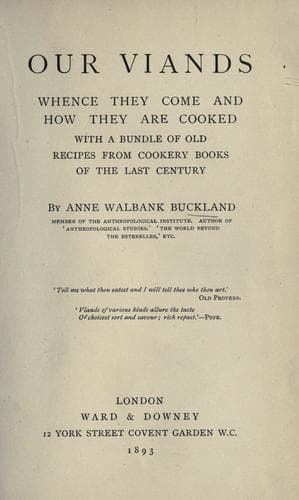
Our viands
1893Anne Walbank Buckland · 155 readable pages · 0 recipe records · culinary history with an appended practical cookbook
From the librarian's dossier · AI-generated, grounded in the scanned text
Our Viands (1893) by Anne Walbank Buckland is part anthropological survey and part practical cookbook, tracing humanity's relationship with food from prehistoric times through the Victorian era. Buckland, writing for a nineteenth-century English readership, moves across continents and centuries, examining bread grains, meats, dairy, fish, exotic foods, spices, fruits, and vegetables before settling into a substantial collection of recipes drawn from eighteenth-century family cookbooks and her own contemporary practice. The book blends scholarly digression, citing classical authors, biblical sources, and archaeological evidence, with hands on kitchen instruction, making it as much a cultural history of eating as a cookery manual. Readers encounter discussions of bread across Egypt, Greece, Rome, and medieval Europe, English festive cakes and puddings, the history of beef and mutton in English tradition, dairy and cheese making, fish and fisheries, unusual foods eaten in other cultures, spices and sugar, nuts and fruits, and finally practical recipes for breads, cakes, pastries, puddings, pies, and roasted meats. The colonial recipes, including South African and Portuguese dishes, reflect the author's own connections. This is a book for readers interested in how Victorian writers understood food history alongside the daily business of cooking, and it rewards patient reading across its wide-ranging chapters.
The book is organized into three broad parts signaled in the section headings: Part I on grains and bread, Part II on meat, and Part III on vegetables, spices, fruits, and related foods. Within these parts, numbered chapters (Chapter I through at least Chapter XIX) move through topics thematically rather than as a simple recipe index, beginning with anthropological and historical material on bread, cakes, and puddings, then meat and dairy, then fish and unusual foods, then spices, nuts, and fruits, then vegetables and salads. The final sections shift register into practical cookery, presenting old recipes from eighteenth-century family cookbooks alongside the author's own modern tried and approved recipes for breads, cakes, pastries, puddings, pies, roasted meats, and vegetable and fruit preserves. An index excerpt appears near the end of section 15.
Read the book
155 readable pages. A dot marks pages with recipe records.