
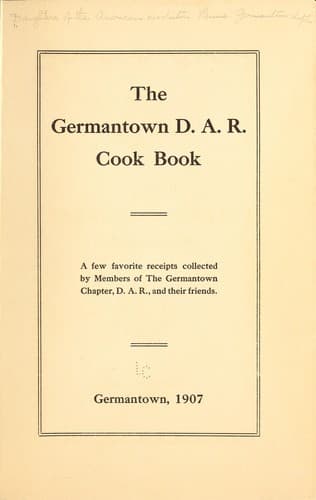
The Germantown D. A. R. cook book
1907Daughters of the American Revolution. Pennsylvania. Germantown chapter · 11 readable pages · 84 recipe records · community household cookbook
From the librarian's dossier · AI-generated, grounded in the scanned text
The Germantown D.A.R. Cook Book (1907) is a community cookbook compiled by members of the Germantown chapter of the Daughters of the American Revolution, gathering recipes contributed by members and their families. It blends elegant company fare, such as Lady Baltimore Cake and Oyster Salad, with plain household staples like Poor Man's Pudding and Johnny-Cake. Several recipes are explicitly noted as heirlooms, described as generations old or tied to old family traditions and prominent estates, reflecting the compilers' stated intent to preserve family recipes before they were lost. The book documents early-twentieth-century American home cooking, including cakes, puddings, pickled goods, breads, and savory dishes, prepared with the tools and techniques of the period, such as saleratus leavening, hand-beaten eggs, and wood or coal stove cooking times. Though brief, with only two mechanically gated sections, the collection offers a window into domestic culinary practice and community identity in early 1900s Pennsylvania. Modern readers will find it useful both as a historical culinary record and as a genealogical and social artifact of a patriotic women's organization documenting its members' family food traditions. The book closes with an index cataloguing its full range of recipes for reference.
The book is organized as a compact recipe collection, presented across two mechanically gated sections. Section 1 forms the bulk of the book, offering a wide-ranging assortment of desserts, cakes, savory dishes, and preserved foods organized loosely by type, with headings for specific items like Short Cake, Washington Cake, Election Cake, and To Pickle Oysters. Section 2 is a short concluding portion containing a handful of additional cake recipes (Devil's Cake, Orange Cake, Chocolate Cake) followed by philosophical quotations about food and nature, and then a comprehensive index listing recipes and their page numbers throughout the book.
Recipes from this book
84 records extracted from the text, showing the first 50 in reading order. Each links to a modern interpretation.
Read the book
11 readable pages. A dot marks pages with recipe records.