
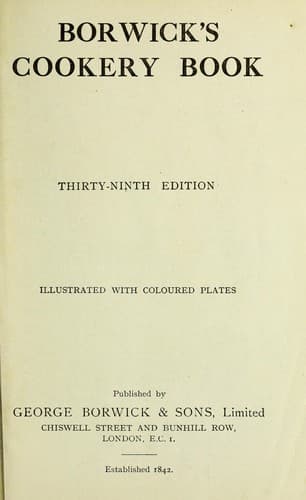
Borwick's cookery book
1890George Borwick & Sons · 22 readable pages · 158 recipe records · commercial baking recipe book (advertising cookbook)
From the librarian's dossier · AI-generated, grounded in the scanned text
Borwick's Cookery Book is a promotional recipe collection issued by George Borwick & Sons, manufacturers of Borwick's Baking Powder, and this copy represents the 39th edition, reflecting a publishing history stretching from 1842 to 1890. Rather than a general household manual, it is a focused compendium of baked goods, cakes, breads, scones, biscuits, pancakes, and puddings, all constructed to showcase the reliability of the company's baking powder as a leavening agent. The book opens with testimonials from cookery schools such as Westminster and the National Training School of Cookery, lending institutional credibility to the product before the recipes even begin. Throughout, Millennium flour and margarine appear as standard ingredients, anchoring the text firmly in late Victorian kitchen practice. With around 159 anchored food records, this is a dense, single-purpose recipe book rather than a broad culinary reference. Modern readers will find it a useful window into commercial cookbook publishing of the period, where recipe instruction and brand advertising were tightly interwoven. The book closes with an extensive index, suggesting it was meant for practical daily reference in the home kitchen, not just as a marketing pamphlet.
The book is organized into three mechanically gated sections that together move through a progression of baked goods. Section 1 opens with an introduction and testimonials promoting Borwick's Baking Powder, then begins a pastry and cake section covering short crusts, tarts, dumplings, and various cakes. Section 2 continues the baking sequence with more cakes, then moves into breads, scones, biscuits, pancakes, and a substantial puddings section. Section 3 concludes the puddings coverage and ends with a comprehensive index listing cakes, biscuits, breads, buns, dumplings, pancakes, and puddings with page references. The overall structure suggests the original book was arranged as a continuous baking-focused recipe sequence rather than divided into conventional courses like soups, meats, or vegetables.
Recipes from this book
158 records extracted from the text, showing the first 50 in reading order. Each links to a modern interpretation.
Read the book
22 readable pages. A dot marks pages with recipe records.