
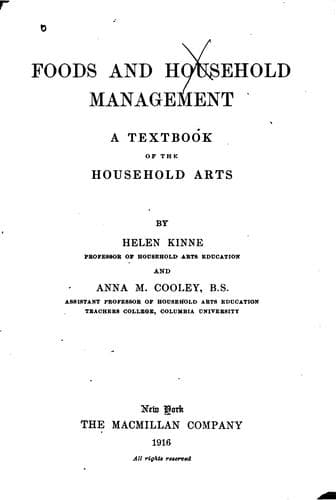
Foods and household management
1914Helen Kinne · 250 readable pages · 141 recipe records · home economics textbook with integrated recipes
From the librarian's dossier · AI-generated, grounded in the scanned text
Foods and Household Management (1914) is a textbook written by Helen Kinne, with Anna M. Cooley credited in the opening material, for use in teaching household arts at the secondary or normal school level. It treats cooking not as a collection of recipes but as an applied science, grounding food preparation in chemistry, nutrition, and economics. The book moves systematically from the composition of food (protein, fat, carbohydrate, mineral matter, water) through kitchen design and fuel selection, into detailed treatment of beverages, fruits, vegetables, cereals, eggs, milk, cheese, fats, sugars, bread, meat, desserts, and meal service. It then broadens into household management proper, covering food costs, family budgeting, textile purchasing, laundering, and cleaning. Throughout, the authors combine scientific explanation, such as starch granule behavior or calorimeter experiments, with practical instructions and recipes. The book reflects an early twentieth-century home economics movement that sought to professionalize domestic work through scientific method and household efficiency, while also addressing consumer awareness under new federal food regulation. Modern readers will find both a historical cooking manual and a window into the era's ideas about nutrition, thrift, and the 'science' of homemaking. It closes with an index and classification tables, plus period advertisements for companion textbooks.
The book is organized as a sequential textbook, opening with a preface and teacher suggestions before moving through numbered chapters (sections 1 through 25 correspond to chapters and subchapters). It begins with food science fundamentals (composition, nutritive value, Calories), then kitchen equipment and fuel (sections 1-2), followed by preparation techniques and beverages (sections 4-5), fruits and vegetables (sections 6-7), cereals, eggs, milk, cheese, fats, and sugars (sections 8-9), bread making and meat (section 11), desserts and meal service (section 14), and then a substantial shift into household management: food costs and purchasing, dietetics, family budgeting, textiles, salads, cleaning, laundering, and a final reference and index section (sections 15-25). Recipes are embedded within topical chapters rather than collected separately, and many sections end with review questions or transition directly into the next chapter's subject.
Recipes from this book
141 records extracted from the text, showing the first 50 in reading order. Each links to a modern interpretation.
Read the book
250 readable pages. A dot marks pages with recipe records.