
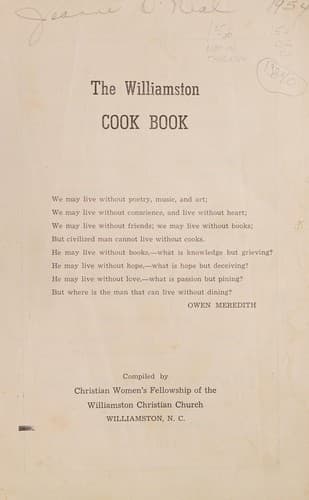
The Williamston cook book
1950N.C.). Christian Women's Fellowship Williamston Christian Church (Williamston · 55 readable pages · 306 recipe records · community church cookbook
From the librarian's dossier · AI-generated, grounded in the scanned text
The Williamston Cook Book is a 1950 community cookbook compiled by the Christian Women's Fellowship of the Williamston Christian Church in North Carolina. Like many church and civic fundraiser cookbooks of its era, it gathers recipes contributed by individual members, most credited by name, into a single practical household reference. Across its sections the book moves through breads, cakes, candies, cookies, desserts, ice creams, icings, sauces, pies, pickles and preserves, meats and seafood, vegetables, and salads, closing with the table of contents that reveals its full scope. The recipes range from everyday staples like biscuits and corn bread to more elaborate offerings such as Japanese fruit cake, lobster Newburg, and chocolate chiffon pie. Household hints on kitchen management, produce selection, meat storage, and quantity cooking for large groups sit alongside the recipes, suggesting the book was meant for both daily family cooking and large church or community gatherings. With around 306 anchored food records, this is a substantial, densely packed volume. For the modern reader it offers a window into mid-twentieth-century Southern home cooking, showing how canned goods, gelatin, and modern oven temperatures were folding into older techniques, and how a congregation's women documented and shared their kitchen knowledge in print.
The book is organized into thematic culinary sections rather than a single alphabetical listing. It opens with household hints, produce and meat guidance, and quantity-serving charts before moving into breads and beverages (section 1). It then proceeds through cakes and candies (section 2), desserts, ice creams, icings, fillings, and dressings/sauces (section 3), sauces, pies, and pickles/preserves leading into meats and seafood (section 4), an extended meats, poultry, seafood, and vegetables section (section 5), and finally salads, additional vegetable dishes, and the table of contents (section 6). The table of contents appears at the end rather than the beginning, and recipes throughout are attributed to individual contributors, reflecting the community-compiled nature of the book.
Recipes from this book
306 records extracted from the text, showing the first 50 in reading order. Each links to a modern interpretation.
Read the book
55 readable pages. A dot marks pages with recipe records.