
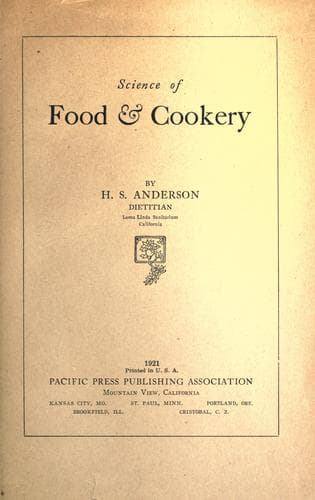
Science of food & cookery
1921H. S. Anderson · 160 readable pages · 436 recipe records · vegetarian household cookbook and nutrition treatise
From the librarian's dossier · AI-generated, grounded in the scanned text
Science of Food and Cookery (1921) by H. S. Anderson is a vegetarian nutrition treatise and household cookbook that blends the era's emerging science of vitamines, minerals, and calories with hundreds of meatless recipes. The opening chapters argue for vegetarianism on scientific, biblical, and ethical grounds, drawing on researchers such as Eijkman and Funk to explain deficiency diseases like beriberi and scurvy and to criticize refined flour and polished rice. From there the book moves into practical territory: food economics, digestion principles, meal planning, and a lengthy course outline for cooking instruction, before delivering recipes for breads, soups, entrees, sauces, vegetables, salads, desserts, cakes, breakfast dishes, sandwiches, invalid cookery, canning, and dairy substitutes. Throughout, the author frames cooking as an extension of physiology, repeatedly tying recipe choices back to mineral content, digestibility, and disease prevention. The book also contains an extended section on diet in disease, covering infectious illness, gastric disorders, and chronic conditions like tuberculosis and diabetes. For modern readers it offers a window into early twentieth-century vegetarian reform cooking, nutritional science in its infancy, and the household economics of the period, all organized with a didactic, almost textbook-like structure suited to home cooking instruction rather than casual browsing.
The book opens with publisher and author prefaces and a nutrition-focused introduction (sections 1-4) covering food classification, vitamines, minerals, and the ethical and scientific case for vegetarianism. This gives way to practical cookery beginning with digestion and menu-planning principles and a formal course outline of cooking lessons (sections 5-6). The recipe chapters then proceed roughly by course: breads both fermented and unfermented (sections 6-7), soups and entrees (sections 8-9), gravies, sauces, and vegetables (sections 10-11), salads and dressings (section 11), desserts, pies, cakes, and cookies (sections 12-13), breakfast dishes, eggs, and sandwiches (section 13), invalid cookery and diet in disease (section 14), canning, preserving, and frozen desserts (section 15), and finally cultured dairy products, staple preparations, and an index of cross-referenced recipes (section 16). The organization moves from theory to practice, then through a standard meal-course sequence, ending with preservation techniques and reference material.
Recipes from this book
436 records extracted from the text, showing the first 50 in reading order. Each links to a modern interpretation.
Read the book
160 readable pages. A dot marks pages with recipe records.