
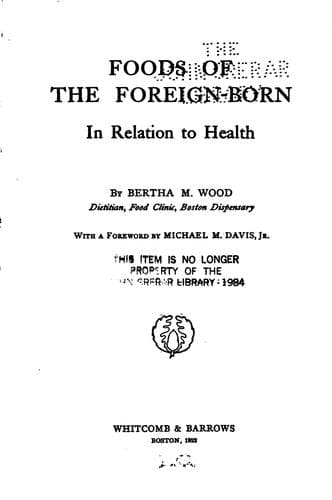
Foods of the foreign-born in relation to health
1922Bertha M. Wood · 41 readable pages · 106 recipe records · public health cookbook and ethnographic dietary study
From the librarian's dossier · AI-generated, grounded in the scanned text
Published in 1922, Foods of the Foreign-Born in Relation to Health by Bertha M. Wood is a public health text aimed at physicians, dietitians, and social workers who worked with immigrant communities in the United States. Rather than a conventional household cookbook, it is a professional guide that surveys the food traditions of Mexican, Portuguese, Italian, Hungarian, Polish, Slovenian, Russian, Armenian, Syrian, Turkish, Greek, and Jewish immigrant populations. For each group, Wood describes homeland agricultural life, staple foods, cooking customs, and sample menus, then supplies recipes adapted to American ingredients and markets. Her central argument is that health professionals achieve better outcomes by working within immigrants' existing food cultures rather than insisting on wholesale adoption of American eating habits. The book pays particular attention to therapeutic diets, showing how traditional dishes can be modified for patients with conditions such as diabetes, nephritis, tuberculosis, and constipation, including detailed treatment of Jewish dietary law and kosher practice. Modern readers will find a snapshot of immigrant daily life in the early twentieth century, expressed through breakfast, lunch, and dinner patterns across social classes, alongside recipes that blend ethnographic description with practical nutrition advice. It is as much a document of period social medicine as it is a recipe collection.
The book is organized as a sequence of nationality-based chapters rather than by ingredient or course. Section 1 opens with a preface and foreword laying out the public health rationale, then begins the survey with Mexicans, Portuguese, and Italians. Section 2 continues with Italians and moves into Hungarian families, using class-based weekly menus (field worker, city worker, well-to-do family) to show economic variation within a single nationality. Section 3 covers Polish, Slovenian, Russian, and introduces Eastern Mediterranean peoples (Armenian, Syrian, Turkish, Greek), again using sample daily menus. Section 4 concludes with Near Eastern dishes and an extended treatment of Jewish dietary law, koshering methods, holiday foods, and therapeutic diets for specific illnesses. Within each nationality section, the pattern repeats: background on homeland diet and agriculture, description of adaptation challenges in America, sample menus, and recipes.
Recipes from this book
106 records extracted from the text, showing the first 50 in reading order. Each links to a modern interpretation.
Read the book
41 readable pages. A dot marks pages with recipe records.