
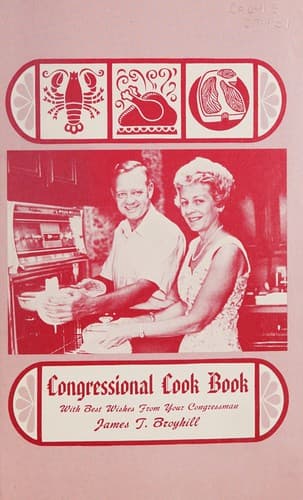
Congressional cook book
1900James T. Broyhill · 11 readable pages · 56 recipe records · community and institutional cookbook
From the librarian's dossier · AI-generated, grounded in the scanned text
This dossier covers the Congressional Cook Book, catalogued with a publication year of 1900 but whose section summaries describe content clearly drawn from later twentieth century Congressional dining culture, including recipes attributed to contributors from the 1970s and 1980s such as Ronald Reagan and Gerald Ford. The book is a community style collection assembled around Congressman James T. Broyhill (also appearing as James J. Broyhill in the material), opening with a welcoming letter and a practical guide to weights, measurements, and ingredient substitutions. From there it moves through appetizers, soups, salads and dressings, an extensive run of vegetable casseroles, and main dishes built around meats, poultry, and sauces. A short closing section adds a barbecue sauce recipe and the origin story of Capitol Bean Soup, tied to Speaker Joseph G. Cannon's reported 1904 order that the soup be served daily in congressional dining rooms. Readers should treat this as a compiled institutional and political memorabilia cookbook rather than a single author's culinary treatise. The mix of home style casseroles, dips, and institutional dishes gives a flavor of official Washington entertaining and self presentation through food, filtered through the contributions of elected officials and their families.
The book is organized into two mechanically gated sections. Section 1 spans the bulk of the material, opening with an introductory letter and a measurements and substitutions guide, then moving through appetizers and soups, salads with dressings and relishes, a long run of vegetable casseroles, and main dishes featuring meats, poultry, and sauces. Section 2 is a single page that closes the book with a barbecue sauce recipe and a historical note on Capitol Bean Soup, including its own recipe. The overall arrangement follows a familiar community cookbook pattern: front matter and reference material, then courses in a loose progression from starters to mains, with a short historical appendix at the end.
Recipes from this book
56 records extracted from the text, showing the first 50 in reading order. Each links to a modern interpretation.
Read the book
11 readable pages. A dot marks pages with recipe records.