
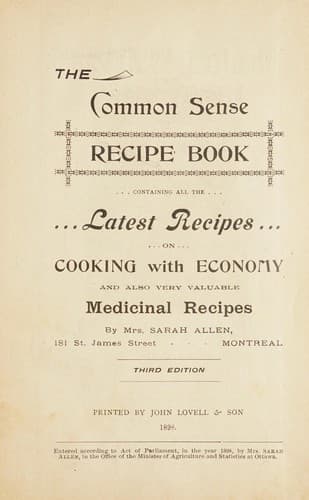
The Common sense recipe book
1898Sarah Allen · 105 readable pages · 396 recipe records · general household cookbook
From the librarian's dossier · AI-generated, grounded in the scanned text
The Common Sense Recipe Book (1898) by Sarah Allen is a substantial late-Victorian household manual blending nearly 400 recorded food preparations with household remedies, cleaning advice, and invalid care. Opening with menus, or Bills of Fare, for lunches, breakfasts, dinners, and teas, it moves into soups, fish, and meats before covering sauces, poultry, vegetables, salads, pickles, eggs, preserves, frozen desserts, puddings, pies, breads, cakes, cookies, frostings, homemade wines, candies, and finally a closing section of medicinal remedies and domestic tips. The preface assures readers the recipes were tested by experienced chefs, positioning the book as a practical, reliable guide. Throughout, the text references commercial products of the era, such as Bovril meat extract, Cottolene shortening, and Eagle Baking Powder, situating it within the branded-ingredient kitchen culture of the 1890s. Numerous period advertisements for Montreal businesses, including bedstead makers, rubber companies, and kitchen equipment retailers, are interspersed among the recipes, suggesting the book doubled as a commercial publication. The inclusion of named contributors for some recipes hints at a community or subscription cookbook tradition. For the modern reader, this is a window into the domestic economy, entertaining customs, and home medicine of a North American household at the close of the nineteenth century.
The book runs across eleven sections organized by course and category, beginning with front matter, advertisements, and Bills of Fare menus, then soups, fish, and meats (sections 1 through 3), sauces and poultry (section 4), vegetables and salads (section 5), pickles and eggs (section 6), preserves and frozen desserts (sections 6 and 7), puddings and pies (sections 7 and 8), breads and cakes (section 9), cakes, cookies, frostings, wines, and invalid drinks (section 10), and finally candies, household remedies, cleaning advice, and a table of weights and measures (section 11). Recipes are grouped under descriptive capitalized headings, with period advertisements for Montreal businesses interspersed throughout rather than isolated in front or back matter.
Recipes from this book
396 records extracted from the text, showing the first 50 in reading order. Each links to a modern interpretation.
Read the book
105 readable pages. A dot marks pages with recipe records.