
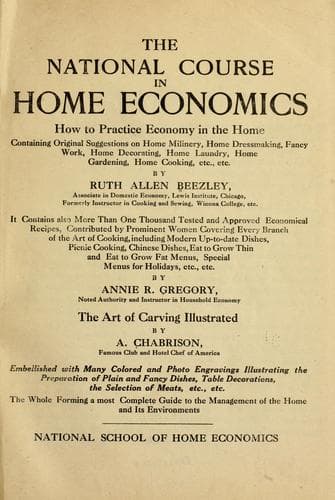
The national course in home economics
1917Ruth Allen Beezley · 404 readable pages · 1,841 recipe records · general household and home economics course (cookbook combined with domestic management, nursing, and grooming manual)
From the librarian's dossier · AI-generated, grounded in the scanned text
The National Course in Home Economics (1917) by Ruth Allen Beezley is a sprawling domestic manual that combines cookery with the full range of early twentieth-century household instruction. Presented as a comprehensive course rather than a simple recipe collection, it opens with cooking times, nutrition science, and dressmaking and millinery instruction before moving into thousands of recipes gathered from named contributors across the country. The book covers meal planning and formal dinner service, meat and fish cookery, baking, preserving, vegetarian cookery, fireless cooker and casserole methods, and finishes with chapters on household chemistry, sickroom nursing, infant care, home remedies, and personal grooming. It reflects a period when the homemaker was expected to be cook, seamstress, nurse, and household chemist all at once, and when domestic science presented itself as both a practical skill and a modern, semi-professional discipline. With roughly 1,800 anchored food recipes alongside a smaller number of household and medicinal entries, this is above all a working kitchen and household reference, assembled collaboratively from many contributors rather than authored as a unified narrative. Modern readers will find it a rich window into contemporary domestic life, nutrition beliefs, entertaining customs, and home remedies, though its recipes, tools, and health advice must be read as artifacts of their era rather than as guidance to follow directly.
The book proceeds through a long, loosely thematic sequence rather than a strict alphabetical dictionary format. It opens with reference material (cooking times, nutrition tables, an introduction on the modern homemaker) and instructional chapters on dressmaking and millinery (sections 1-2), then moves into meal planning, etiquette, and economical cooking (sections 3-4). A long central run covers carving, soups, fish and shellfish, poultry and game, and butcher's meats (sections 5-10), followed by breads and baked goods (sections 11-12), sandwiches, cheese, and eggs (sections 13-14), chafing dish cookery, salads, and pastry (sections 15-16), and an extensive dessert sequence covering cakes, cookies, puddings, custards, frozen desserts, and confectionery (sections 18-24). Beverages and food preservation (canning, pickling, vinegars, sauces) occupy sections 25-28, followed by condiments, garnishes, camp cookery, and a pivot into vegetarian cookery, nuts, legumes, and vegetables (sections 29-33). Later sections cover salads and modern cooking technologies such as the fireless cooker and casserole (sections 34-35), then shift decisively away from food into household chemistry and cleaning, sickroom nursing and invalid diet, infant feeding, home remedies, and beauty and grooming (sections 36-39), before a final miscellany of pest control, party foods, and remedy indices (section 40).
Recipes from this book
1,838 records extracted from the text, showing the first 50 in reading order. Each links to a modern interpretation.
Read the book
404 readable pages. A dot marks pages with recipe records.