
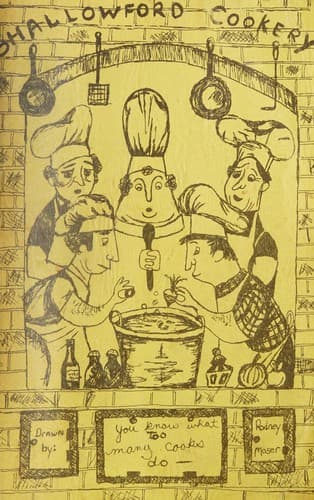
Shallowford cookery
1951Marie Koury · 32 readable pages · 163 recipe records · community household cookbook with a Lebanese and Mediterranean heritage section
From the librarian's dossier · AI-generated, grounded in the scanned text
Shallowford Cookery is a 1951 community cookbook compiled by Marie Koury that brings together two culinary worlds under one cover: Lebanese and Mediterranean home cooking alongside mainstream 1950s American fare. The book opens by defining unfamiliar ingredients such as tahini, feta cheese, and cracked wheat, signaling its intent to introduce readers to dishes like kibi, tabbouleh, stuffed grape leaves, and baklawa. From there it moves into a broad range of American dishes typical of the era's community cookbooks, including casseroles, pickles, cakes, pies, and candies, many apparently contributed by members of a local community. The result is a hybrid volume that reads partly as a cultural bridge for readers unfamiliar with Middle Eastern cooking and partly as a standard mid-century household reference. Practical matter such as measurement equivalents, substitutions, and household hints rounds out the book, along with an index and a page of recipe corrections. For a modern reader, the book offers a window into how one family or community combined heritage recipes with the conventions of postwar American home cooking, presented in the plain, hint-laden style typical of church and club cookbooks of the period.
The book is organized into a small number of large sections rather than many short chapters. Section 1 opens with definitions of unfamiliar ingredients, cooking hints, and a dedication, then moves through appetizers, soups, salads, rice and yogurt dishes, main courses, and Middle Eastern desserts. Section 3 shifts into American-style categories: main courses, pickles and preserves, desserts, candies, pies, and cakes, closing with hints and equivalent measures. Section 4 functions as a reference appendix, containing measurement equivalencies, ingredient substitutions, household hints, an index of the book's sections, and a page of corrections to specific recipes. The overall arc moves from introductory material and heritage dishes toward general American dessert and pickling recipes, then ends with practical reference tools.
Recipes from this book
163 records extracted from the text, showing the first 50 in reading order. Each links to a modern interpretation.
Read the book
32 readable pages. A dot marks pages with recipe records.