
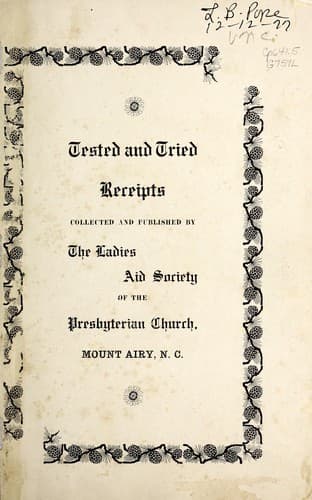
Granite City cook book
1900Ladies Aid Society of the Presbyterian Church (Mount Airy, N.C.) · 26 readable pages · 146 recipe records · community household cookbook
From the librarian's dossier · AI-generated, grounded in the scanned text
The Granite City Cook Book is a community fundraising cookbook compiled in 1900 by the Ladies Aid Society of the Presbyterian Church in Mount Airy, North Carolina. Like many church and charity cookbooks of its era, it gathers recipes contributed by local women, mixing everyday household fare with more festive dishes suited to gatherings and celebrations. Readers will find a broad sweep of American home cooking from that period: breads and biscuits, an abundance of cakes, salads and dressings, egg and fish dishes, frozen desserts, meats, pies, puddings, soups, and preserved fruits. The recipes reflect the kitchen technology and staple ingredients of the turn of the century, including molasses, buttermilk, gelatin, and cream as common binding and flavoring agents. Interspersed throughout are advertisements from Mount Airy businesses, which situates the book firmly as a local, community-funded production rather than a commercially authored guide. For modern readers, the book offers a window into small-town Southern domestic life circa 1900, its instructions terse and assuming considerable prior kitchen knowledge. With 146 anchored food records across just three mechanically gated sections, this is a compact but rich culinary artifact, valuable both as a historical cooking reference and as a piece of local Mount Airy social history.
The book is organized into three sections that progress through courses and categories rather than a strict alphabetical index. Section 1 opens with breads and biscuits before moving into a large cluster of cakes, followed by candies, catsups, cheeses, and fritter-type desserts. Section 2 continues from salad dressings into eggs, fish and seafood (including oysters), pickled vegetables and relishes, frozen desserts, and substantial meat dishes such as croquettes and pressed chicken. Section 3 closes the book with pies, potato dishes, preserved fruits, puddings, sandwiches, soups, tomato preparations, and miscellaneous items like fruit punch and household hints. Local business advertisements are interspersed throughout all three sections, a common feature of community-produced cookbooks used to offset printing costs.
Recipes from this book
146 records extracted from the text, showing the first 50 in reading order. Each links to a modern interpretation.
Read the book
26 readable pages. A dot marks pages with recipe records.