
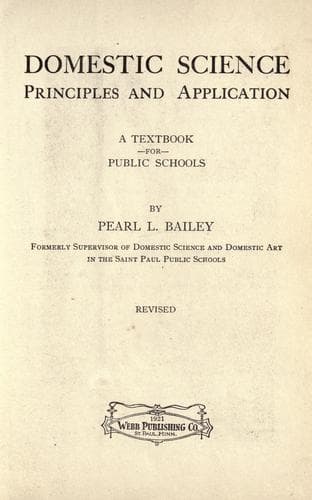
Domestic science, principles and application
1914Pearl La Verne Bailey · 151 readable pages · 324 recipe records · domestic science textbook and household cookbook
From the librarian's dossier · AI-generated, grounded in the scanned text
Domestic Science, Principles and Application (1914) by Pearl La Verne Bailey is a public school textbook designed to teach girls the theory and practice of home economics through a structured two-year, 64-lesson curriculum. Rather than a simple recipe collection, it blends kitchen chemistry, hygiene, nutrition science, household management, and practical cookery into a single teaching tool. Readers move from foundational topics such as heat, combustion, and food classification through protein sources (eggs, milk, meat, poultry), carbohydrates (potatoes, cereals, breads), preservation methods, and on to desserts, table service, and even emergency first aid. The book also documents school lunch programs, classroom equipment lists, and household accounting, reflecting its origin as an instructional manual for domestic science classrooms rather than a home kitchen reference alone. With over 300 anchored food records spanning canning, pickling, candy-making, invalid cookery, and formal dining etiquette, the text offers a panoramic view of early twentieth-century American food preparation as taught in institutional settings. Modern readers will find it valuable both as a historical culinary reference and as a window into how domestic science was formalized as an academic subject, complete with lesson plans, teacher guidance, and student equipment specifications alongside hundreds of period recipes.
The book opens with front matter and a preface explaining its two-year, 64-lesson curriculum (section 1), then proceeds through topical units: kitchen hygiene and equipment care (sections 1-2), heat and carbohydrate foods like potatoes, vegetables, and cereals (section 3), protein foods including eggs, milk, cheese, and beverages (sections 5-6), bread making and meat cookery organized by cut and animal (sections 7-8), food preservation via canning, jelly-making, and pickling (sections 9-10), pastry, candy, and fish/shellfish (section 11), salads, cakes, desserts, and sandwiches (section 12), frozen desserts and formal table service (section 13), meal service, school luncheons, invalid cookery, and first aid (section 14), and finally equipment lists, school lunch program case studies, and score cards (section 15), closing with an index (section 16). The organization follows a pedagogical progression rather than a simple alphabetical recipe format, moving from scientific principles to increasingly complex applications.
Recipes from this book
324 records extracted from the text, showing the first 50 in reading order. Each links to a modern interpretation.
Read the book
151 readable pages. A dot marks pages with recipe records.