
Superior cook book
1905Grace Church (Ishpeming, Mich.) · 134 readable pages · 710 recipe records · community household cookbook
From the librarian's dossier · AI-generated, grounded in the scanned text
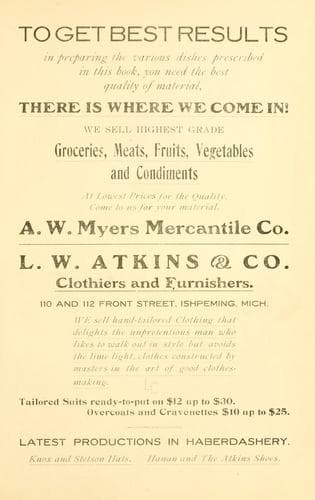
The Superior Cook Book is a community fundraising cookbook compiled by the Women of Grace Church in Ishpeming, Michigan, and published in 1905. Organized like many church and club cookbooks of its era, it moves through the standard courses of a well-appointed American household menu: soups, fish, meats, breakfast and luncheon dishes, pies, puddings, frozen desserts, cookies, cakes, and preserves. The recipes are attributed to named local contributors, reflecting its origin as a collaborative parish project rather than the work of a single author or professional chef. Modern readers will find it a window into early twentieth-century domestic cooking in a Michigan mining town, with recipes ranging from everyday fare like baked beans and pot roast to more elaborate entertaining dishes such as jellied tongue and veal or lobster bisque. The book also carries traces of contemporary commercial life, with repeated references to Dousman's Best Patent flour and the Jewel Range oven suggesting embedded advertising typical of the genre. With over 700 anchored food records and only a single household record, this is overwhelmingly a cookbook rather than a general household manual, offering a detailed and abundant record of what a comfortable Midwestern American kitchen prepared and served at the turn of the twentieth century.
The book is arranged by course and category in a sequence typical of period cookbooks: it opens with soups and fish and oyster dishes (section 1), moves to an extensive meats section covering beef, veal, lamb, pork, venison, and poultry (section 2), then to breakfast and luncheon dishes and chafing dish preparations (section 6), followed by pies (section 7), puddings and sauces (section 8), frozen desserts, jellies, and cookies (section 9), cookies concluding into a large cakes section with foundational baking rules (section 10), and finally jellies, jams, preserves, marmalades, and pickles (section 12). Section headings within each part group recipes by specific dish or technique, such as Yorkshire Pudding under meats or Pie Plant Pie under pies. The gaps in section numbering suggest the original volume likely contained additional material, such as sections 3 through 5 and 11, not present in the summarized material provided here.
Recipes from this book
710 records extracted from the text, showing the first 50 in reading order. Each links to a modern interpretation.
Read the book
134 readable pages. A dot marks pages with recipe records.