
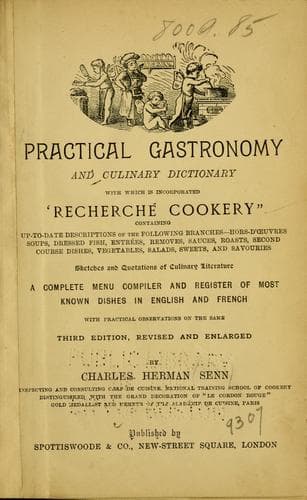
Practical gastronomy and culinary dictionary
1892Charles Herman Senn · 423 readable pages · 0 recipe records · professional culinary encyclopedia and menu reference
From the librarian's dossier · AI-generated, grounded in the scanned text
Practical Gastronomy and Culinary Dictionary is an 1892 professional reference by Charles Herman Senn, appearing here in its third (1895) edition. It combines a vast recipe collection, a bilingual French-English culinary dictionary, historical essays on cookery, biographical sketches of celebrated chefs, and roughly two hundred specimen menus. Aimed at cooks, household managers, and hotel professionals, the book presents itself as a complete oracle of gastronomy, tracing cookery from Roman times through the nineteenth century while defending English cooking against claims of French superiority. The bulk of the volume catalogs haute cuisine dishes organized by protein and course, French sauces and forcemeats, elaborate cold and iced desserts, and pastry work, alongside chapters on stocks, garnishes, carving, wine service, and menu composition. Readers will find both practical technique, such as instructions for clarifying stock or trussing poultry, and cultural material, including historical menus from centuries past and essays on dining customs across nations. The dictionary sections at the end define hundreds of culinary terms alphabetically. Modern readers should approach this as a snapshot of professional Victorian-era kitchen practice rather than a simple home cookbook, useful for understanding the vocabulary, structure, and ambitions of formal French-influenced cookery in late nineteenth-century Britain.
The book opens with prefatory material and a historical survey of cookery (section 1), followed by gastronomic maxims and foundational cooking notes (section 3). The main body, sections 5 through 30 and 32 through 34, proceeds through an extensive sequence of recipes organized by course and protein: fish, releves, entrees of beef, lamb, mutton, pork, poultry, and game; vegetables and salads; sauces; sweet dishes, jellies, ices, and savouries; techniques and stocks; consommes and soups; garnishes and dressed fish; cold service and aspic work; more meat and game entrees; roasts and carving; and an extensive run of desserts, pastries, cakes, and biscuits. Later sections shift into reference material: an index of recipes by course (section 34), a long run of specimen menus from hotels, clubs, banquets, and historical occasions (sections 35 and 36), notes on carving, wine service, and literary quotations about food (section 37), biographical sketches of famous chefs (sections 38 and 39), and finally an alphabetical culinary dictionary running from A to Z (sections 39 through 42), closing with a general index (section 43).
Read the book
423 readable pages. A dot marks pages with recipe records.