
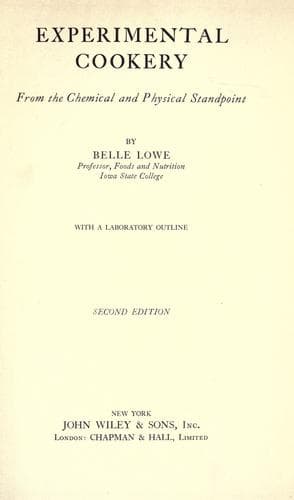
Experimental cookery
1932Belle Lowe · 477 readable pages · 0 recipe records · experimental food science textbook
From the librarian's dossier · AI-generated, grounded in the scanned text
Experimental Cookery (1932) by Belle Lowe is a college-level food science textbook rather than an ordinary recipe collection. Growing out of laboratory work at Iowa State College, it explains cookery through colloid chemistry, physics, and biochemistry, showing why sugar syrups crystallize, why proteins coagulate, why bread rises, why mayonnaise emulsifies, and why fats turn rancid. Recipes and kitchen procedures do appear, but chiefly as outcomes of structured experiments designed to isolate variables such as temperature, mixing time, acidity, and ingredient ratios. The book ranges widely across candy and ice cream, fruits and vegetables, legumes, jellies and gelatin, meat and poultry, milk and cheese, eggs, breads, leavening agents, batters and cakes, and fats and oils. Each topic is presented with technical vocabulary, citations of contemporaneous researchers, data tables, and numbered classroom experiments. For a modern reader, the book is a window into how home economics and food science were converging in American academic settings in the early 1930s, documenting federal meat grading standards, sugar and starch chemistry, and nutrient-loss studies of the period. It rewards patient, selective reading and is best treated as a historical scientific reference rather than a practical cookbook for casual kitchen use.
The book proceeds from foundational chemistry to specific food categories across numbered chapters. It opens with an introduction and a chapter on colloid chemistry (sections 1-3), then covers sugar and candy chemistry (sections 4-6), freezing and ice cream (sections 8-9), fruit and vegetable cookery including legumes (sections 9-12), preserves, jelly, and pectin chemistry (sections 13-15), gelatin and federal meat grading (sections 15-16), meat composition, storage, and cookery (sections 17-22), emulsions and mayonnaise (sections 22-23), milk and cheese chemistry (sections 25-27), eggs and egg dishes including custards, meringues, and omelets (sections 27-31), wheat flour, starch, and bread chemistry (sections 32-37), leavening agents and batters such as popovers, muffins, biscuits, and cakes (sections 37-43), and fats, oils, and frying science (sections 44-47). Each chapter combines narrative scientific explanation, citations of named researchers, data tables, and numbered laboratory experiments with precise procedures and evaluation criteria, often closing with a bibliography.
Read the book
477 readable pages. A dot marks pages with recipe records.