
FoodNet
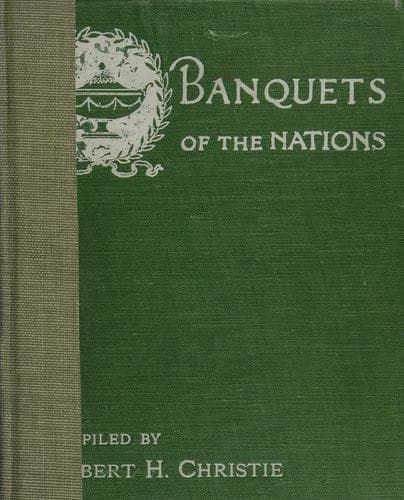
Cover of Banquets of the nations

Banquets of the nations

1911

Robert H. Christie · 272 readable pages · 1,116 recipe records · international cookbook of national dinners and menus

From the librarian's dossier · AI-generated, grounded in the scanned text

Banquets of the Nations (1911) is an ambitious international cookbook compiled by Robert H. Christie, presenting eighty-six dinners meant to represent the characteristic cookery of countries and peoples around the world. Rather than a single national tradition, the book moves alphabetically through nations and regions, from Afghanistan and Algiers through China, India's many regional and religious communities, the Middle East, Scandinavia, the Balkans, and the Americas, closing with Turkey, Switzerland, and a short section on paper bag cookery. Each section typically opens with a formal multi-course menu and follows with detailed recipes rendered in the vocabulary and technique of European, especially French-influenced, professional kitchens. Christie draws on consuls, missionaries, and reference works to describe not only dishes but also dining customs, table settings, and service rituals, particularly contrasting Eastern simultaneous service with Western courses. The recipes range from elaborate haute cuisine preparations (sauces, forcemeats, molded desserts) to exotic regional staples like bird's nest soup, kesksoo, and fermented mare's milk. For the modern reader, this is less a practical daily cookbook than a document of Edwardian curiosity about world cuisines, filtered through colonial and diplomatic networks and adapted for European kitchens. It offers a rich, if dated, window into how one compiler imagined global culinary diversity at the start of the twentieth century.

The book is organized as a sequence of numbered national and regional sections, arranged roughly alphabetically by country or people (Afghanistan, Africa, Algiers, America, Arabia, Argentine, Armenia, Brazil, Bulgaria, and onward through dozens of nations to Turkey, Switzerland, and finally a short chapter on cooking in paper bags). Several large nations, notably China and India, are broken into multiple sub-sections by region or community (North-West and South-East China; Burma, Central Provinces Brahmin and Mussulman, Ceylon, Kashmir, Madras, Mysore, Nepal, Parsee, Punjab, Rajputana). Each section typically begins with a formal printed menu followed by the recipes needed to prepare it, and some sections include supporting notes on sauces, stocks, or foundational techniques (ghee clarification, garam masala, Benedictine essence). The book closes with a cooking-time chart for paper bag cookery and an index of soups organized by origin and ingredient.

Several recipes call for ingredients or practices modern readers may find unsafe, obsolete, or difficult to source, including sea slugs, shark's fins, bird's nest soup, sheep's brains, and raw or lightly cooked game and poultry preparations typical of the period. Some entries, such as a two-year-aged homemade liqueur formula, involve lengthy or specialized processes not suited to casual replication. Measurements and cooking times are frequently vague by modern standards, relying on visual cues rather than precise temperatures. The transliterated non-English recipe titles are inconsistent and may contain OCR or transcription errors, and the ethnographic framing of dining customs across cultures reflects period attitudes that modern readers should approach critically rather than as authoritative anthropology.

Start reading →

Recipes from this book

1,116 records extracted from the text, showing the first 50 in reading order. Each links to a modern interpretation.

Leavened Brown Breadp. 12Yeastp. 12Unleavened Brown Breadp. 12Pillau-i-Rarah (Pillau of Lamb)p. 12Stewed Venison (Kaurmah-i-Ahu)p. 13Arrowroot Pudding (Halwa Nashashta)p. 13Buttered Beetrootsp. 13Stewed Chicken (Kaurmah-i-Chuchai Murgh)p. 13Buttered Parsnipsp. 13Sherbet (Sharbai)p. 14Stewed Parsnipsp. 14Biltong (Dried Beef)p. 14Kerrie Soep (Curry Soup)p. 15Gesmoorde Makreel (Stewed Mackerel)p. 15Swartzuir (Braised Venison)p. 15Bobotee (Curried Mince)p. 16Blatjang (Savoury Condiment)p. 16Gesmoorde Hoender (Stewed Chicken)p. 16Rys Kluitjes (Rice Dumplings)p. 16Rice Dumplingsp. 16Apricot Saucep. 16Curried Quails and Sweet Potatoesp. 16Sweet Potatoesp. 16Cocoanut Tartp. 17Sweet Dumplingsp. 17Guava Saladp. 17Macaroonsp. 17Apricot Rice Creamp. 17Kefta (Pigeon Rissoles)p. 18Tadjim bel Bergoug (Braised Fowl and Eggs)p. 18Tadjim bel Beidh (Braised Lamb)p. 18Mesfouf (Semolina Pudding)p. 19Murabbit Tin (Stuffed Figs)p. 19Temer (Stewed Dates)p. 19Halouiat Mokhtalifa (Honey Tartlets)p. 19Almond Cakesp. 19Clam Soupp. 19Tomato Soupp. 19Stewed Terrapinsp. 19Oyster Omelette Soufflep. 19Curried Calves' Feetp. 20Chicken Pot Piep. 20Cranberry Saucep. 21Orange Punchp. 21Hominy Croquettesp. 22Piquante Saucep. 22Crab Savouryp. 22Crab with Eggsp. 22Pumpkin Piep. 22Strawberry Puddingp. 22

Browse all 1,116 records →

Read the book

272 readable pages. A dot marks pages with recipe records.

0123456789101112131415161718192021222324252627282930313233343536373839404142434445464748495051525354555657585960616263646566676869707172737475767778798081828384858687888990919293949596979899100101102103104105106107108109110111112113114115116117118119120121122123124125126127128129130131132133134135136137138139140141142143144145146147148149150151152153154155156157158159160161162163164165166167168169170171172173174175176177178179180181182183184185186187188189190191192193194195196197198199200201202203204205206207208209210211212213214215216217218219220221222223224225226227228229230231232233234235236237238239240241242243244245246247248249250251252253254255256257258259260261262263264265266267268269270271