
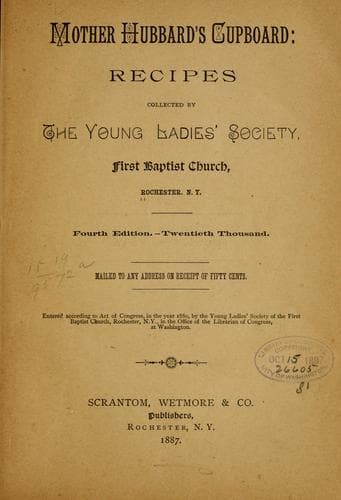
Mother Hubbard's cupboard
188737 readable pages · 288 recipe records · general household cookbook
From the librarian's dossier · AI-generated, grounded in the scanned text
Mother Hubbard's Cupboard is a community cookbook compiled by the Young Ladies' Society of the First Baptist Church in Rochester, New York, first published in 1880 with a copyright reissue in 1887. Like many charitable and church-fundraiser cookbooks of its era, it gathers recipes attributed to individual contributors, covering the full span of a nineteenth-century American household kitchen: soups, fish, meats, vegetables, breads, pies, puddings, cakes, molded desserts, pickles, preserves, salads, beverages, and candies. The book moves from savory staples toward increasingly elaborate desserts and confections, closing with practical household preservation techniques like large-batch pickling and canning. With 288 anchored food records, it offers a dense, practical record of domestic cooking practice, useful both as a working recipe collection and as a window into the food culture of a Baptist congregation's home cooks in the 1880s. Readers should expect terse, instructive prose typical of the period, with an emphasis on economy, seasonal preservation, and entertaining (wedding cakes, elegant molded charlottes) alongside everyday fare (bread, chowder, pot pie). The absence of a named author reflects its collective, community-sourced origin rather than a single culinary voice.
The book is organized into four sections that follow a rough progression from savory to sweet to preserved goods. Section 1 opens with soups, fish, meats and sauces, vegetables, general directions, and bread. Section 2 continues bread varieties before moving into pies and an extensive puddings and desserts section, including sauces and technique notes. Section 3 covers molded desserts and custards, a large cake section ranging from simple cookies to wedding cakes, and then pickles and preserved condiments. Section 4 concludes with more pickling and canning, salads, beverages, a substantial sweets and candy section, and a miscellaneous closing section that folds in additional cakes, puddings, breads, and condiments. Headings within each section (such as SOUPS, BREAD, Cake, PICKLES, SALADS, BEVERAGES, SWEETS) mark the internal divisions.
Recipes from this book
288 records extracted from the text, showing the first 50 in reading order. Each links to a modern interpretation.
Read the book
37 readable pages. A dot marks pages with recipe records.