
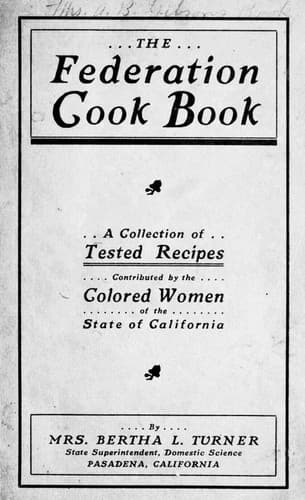
The Federation cook book
1910Bertha L. Turner · 30 readable pages · 193 recipe records · community fundraising cookbook
From the librarian's dossier · AI-generated, grounded in the scanned text
The Federation Cook Book is a 1910 community cookbook compiled by Bertha L. Turner and credited to contributions from colored women of California, drawing recipe submissions from women in Pasadena, Berkeley, Oakland, and Hanford. It belongs to the tradition of fundraising and club cookbooks produced by women's organizations, blending practical domestic recipes with local advertising that funded publication. The book moves through soups, fish, meats, breads, vegetables, salads, sandwiches, puddings, pies, desserts, ice creams, and preserves, reflecting the full scope of an early twentieth-century American household kitchen. Readers will find both everyday dishes and more elaborate Victorian-style entertaining fare such as timbales, jellied salads, and molded desserts. The presence of named contributors ties individual recipes to specific women and communities, giving the collection a documentary quality beyond simple instruction. Interspersed advertisements for Pasadena businesses situate the book firmly within a specific regional and social network, showing how the cookbook doubled as a community directory. For modern readers, the book offers a window into regional African American culinary contributions in early 1900s California, as well as broader period cooking techniques, measurements, and serving conventions that have since fallen out of common use.
The book is organized into three broad sections that move from savory to sweet. Section 1 opens with dedicatory material, verses, and a menu before moving into soups, fish and oyster dishes, meats, breads, and vegetables. Section 2 continues with an extensive run of salads and dressings, sandwiches, and then transitions into puddings, pies, and the start of a general desserts section. Section 3 completes the dessert offerings with ice creams, ices, and sherbets, then moves into preserves, jellies, and candies, closing with an index and further merchant advertisements. Local business advertisements are interspersed throughout all three sections rather than confined to front or back matter.
Recipes from this book
193 records extracted from the text, showing the first 50 in reading order. Each links to a modern interpretation.
Read the book
30 readable pages. A dot marks pages with recipe records.