
The Chapel Hill cook book
1935Presbyterian Church (Chapel Hill, N.C.). Woman's Auxiliary · 48 readable pages · 280 recipe records · community fundraising cookbook (general household cookbook)
From the librarian's dossier · AI-generated, grounded in the scanned text
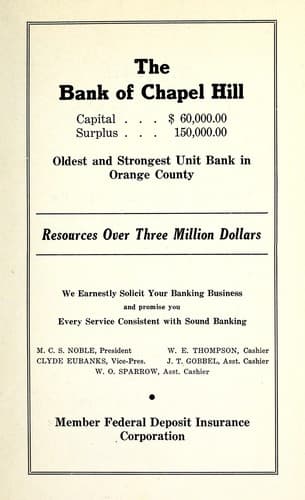
The Chapel Hill Cook Book is a 1935 community fundraising cookbook compiled by the Woman's Auxiliary of the Presbyterian Church in Chapel Hill, North Carolina. Drawing on 280 anchored recipe records, it gathers home recipes contributed by local residents into a comprehensive household reference spanning appetizers, soups, seafood, poultry, meats, vegetables, salads, breads, desserts, pies, cakes, cookies, preserves, pickles, beverages, sandwiches, and candies. The book opens with a foreword explaining its purpose of preserving community recipes, and it is interleaved throughout with advertisements from local Chapel Hill businesses, which helped fund its publication. Many recipes are attributed to named contributors, reflecting the collaborative, small-town character typical of church and civic cookbooks of the period. Modern readers will find a snapshot of 1930s American home cooking, with an emphasis on molded gelatin salads, casseroles, ring molds, ice-box desserts, and preserving techniques for jams and pickles. The recipes rely on period conventions of measurement and technique rather than standardized modern instructions. As a historical document, it offers insight into domestic life, food culture, and community commerce in Depression-era North Carolina, presented through the practical, unpretentious voice of church auxiliary members compiling recipes for their neighbors.
The book is organized into five mechanically gated sections that move through a fairly traditional cookbook progression. Section 1 opens with advertising, a foreword, a table of contents, and a table of weights and measures before beginning with appetizers, soups, seafood, eggs and cheese, and poultry. Section 2 continues into meats, an extensive vegetable section, and a large salad and dressing section. Section 3 covers sauces, breads, and desserts and puddings, transitioning into the start of pastry and pies. Section 4 is devoted to pies, cakes, cookies, and frostings and fillings, with recipes tied to named local contributors. Section 5 closes the book with preserves, pickles, beverages, sandwiches, and candies. Commercial advertisements from Chapel Hill businesses recur throughout every section, interwoven with the recipe content rather than confined to the front or back matter.
Recipes from this book
280 records extracted from the text, showing the first 50 in reading order. Each links to a modern interpretation.
Read the book
48 readable pages. A dot marks pages with recipe records.