
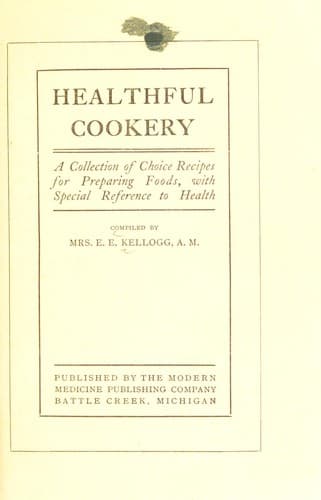
Healthful cookery
1904E. E. Kellogg · 98 readable pages · 454 recipe records · vegetarian household cookbook with health reform instructional content
From the librarian's dossier · AI-generated, grounded in the scanned text
Healthful cookery is a 1904 vegetarian cookbook by E. E. Kellogg, published in the orbit of the Battle Creek Sanitarium health reform movement. It presents itself as a practical, well-tested manual for readers wishing to build daily meals around hygienic cooking principles rather than conventional meat-and-dairy-centered fare. The book opens with foundational cooking methods (broiling, baking, boiling, stewing, steaming) and detailed bread-making instruction, then moves through unfermented breads, sandwiches, and toasts before devoting substantial space to meat substitutes made from manufactured products such as Protose and Nuttolene. Later sections cover eggs, vegetables, breakfast porridges, salad dressings, soups, puddings, pies, cakes, jellies, frozen desserts, and a closing block on invalid cookery and seasonal menu planning. Throughout, the text argues that legumes, nuts, and branded health foods can nutritionally replace flesh foods, while steering readers away from frying and toward baking, steaming, and boiling. With roughly 454 anchored food records, this is a dense, recipe-heavy reference work. It closes with an index and a mail-order catalog for Battle Creek Sanitarium products, revealing the commercial ecosystem that supported the book's dietary philosophy.
The book proceeds from cooking fundamentals to an extensive recipe compendium organized by course and food type. It begins with methods and bread-making (section 1), moves to unfermented breads, sandwiches, and toasts (section 2), then to meat substitutes made from Protose and Nuttolene across two sections (sections 3 and 4), followed by eggs (section 4), breakfast dishes and vegetables (section 5), salads and soups (section 7), puddings, pies, and fruit desserts (section 8), and cakes, jellies, frozen desserts, invalid cookery, and seasonal menus (section 9). It concludes with an alphabetical index and a mail-order price list for Battle Creek Sanitarium health foods (section 10). Headings within sections mark subcategories such as specific vegetables, dessert types, and gruels, indicating a structure organized more by food category than by strict meal sequence.
Recipes from this book
454 records extracted from the text, showing the first 50 in reading order. Each links to a modern interpretation.
Read the book
98 readable pages. A dot marks pages with recipe records.