
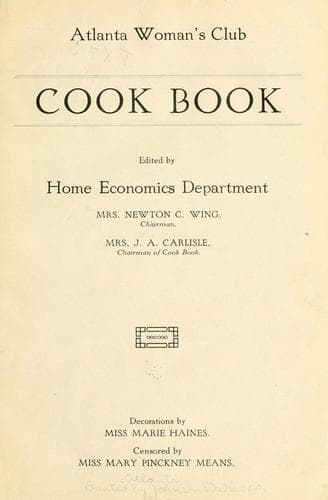
Atlanta women's club cook book
1921Atlanta woman's club · 143 readable pages · 804 recipe records · general household and community club cookbook
From the librarian's dossier · AI-generated, grounded in the scanned text
The Atlanta Woman's Club Cook Book (1921) is a community fundraising cookbook compiled by prominent Georgia clubwomen and tested under the supervision of Miss Mary Means of the Home Economics Department. It gathers over eight hundred anchored food records spanning household staples, elegant entertaining fare, and regional Southern specialties, alongside recipes contributed by governors' wives from across the country and by well-known Atlantans. The book blends practical kitchen management advice, such as equipment lists, gas economy, and temperature and time tables, with an extensive recipe repertoire covering breads, salads, chafing dish cookery, preserves, cakes, candies, meats, soups, and frozen desserts. It also preserves a chapter of heirloom Creole recipes from the Atlanta Woman's Pioneer Society, guidance on home canning from a state agricultural college, advice on home gardening, and a closing section of local business advertisements that funded the volume. Modern readers will find it valuable both as a working recipe collection and as a social document of early twentieth-century Atlanta domestic life, reflecting the era's mix of scientific home economics, Southern culinary tradition, and genteel club entertaining. The presence of advertising, household hints, and civic history alongside recipes marks it as a hybrid publication typical of women's club fundraising cookbooks of its period.
The book is organized into numbered chapters that move from kitchen management and reference material (sections 1 to 2) through categories of dishes: breads and egg dishes (section 3), salads and sandwiches (section 4), chafing dish fare, beverages, and pickles (sections 4 to 5), preserves and cakes (sections 6 to 7), a formal dinner sequence of soups, fish, poultry, and meats (sections 8 to 9), frozen desserts and puddings (section 10), additional baking and Creole and canning material (section 12), preservation and household hints (section 13), and closing chapters on home gardens, special occasion recipes, and advertising (sections 14 to 15). Recipes are frequently grouped by contributor or club committee, and headings often name specific chapters such as Dinners, Needful Facts for Housewives, and Recipes for Special Occasions. The final pages are devoted entirely to local Atlanta business advertisements rather than recipes.
Recipes from this book
804 records extracted from the text, showing the first 50 in reading order. Each links to a modern interpretation.
Read the book
143 readable pages. A dot marks pages with recipe records.