
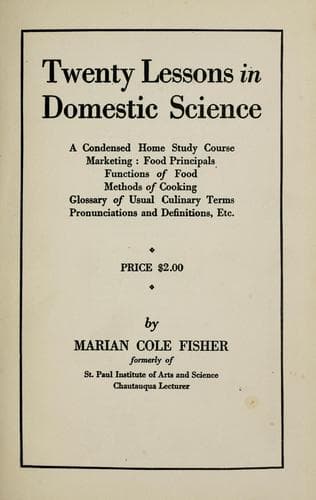
Twenty lessons in domestic science
1916Marian Cole Fisher · 61 readable pages · 85 recipe records · domestic science instructional cookbook
From the librarian's dossier · AI-generated, grounded in the scanned text
Twenty Lessons in Domestic Science is a 1916 home study cookbook by Marian Cole Fisher, organized as a structured course rather than a simple recipe collection. It blends nutritional science, household economy, and practical cookery, walking the reader through the chemistry of food and leavening before moving into cakes, breads, proteins, vegetables, and beverages. The book reflects the domestic science movement's effort to bring laboratory-style rigor, USDA food composition data, and systematic kitchen management into the ordinary home. Numbered lessons cover topics such as the five classes of food, the chemistry of baking powder, egg albumen coagulation, yeast fermentation, meat and fish selection, legumes as meat substitutes, and vegetable and fruit preservation. The final pages address kitchen equipment, efficiency, sanitation, and a glossary of French culinary terms, showing an ambition to professionalize home cooking through both scientific explanation and refined vocabulary. Modern readers will find a curious mixture of textbook instruction, budgeting advice, and recipes for dishes like Devil's Food cake, Chili Con Carne, and Welsh Rarebit. As a period document, it offers insight into how nutrition science, immigrant-influenced dishes, and domestic efficiency ideals converged in early twentieth-century American kitchens.
The book is arranged as a numbered sequence of lessons (Lessons One through at least Eleven, based on section headings) rather than a conventional recipe index. Section 1 opens with introductory material on marketing, family budgets, cooking methods, and measurement equivalents before beginning Lesson One on the function of food and Lesson Two on leavening chemistry. Sections 2 through 5 continue the lesson structure, moving through baking powder chemistry and quick breads, cake and yeast bread lessons, protein lessons on milk, eggs, and cheese, then fish, meat, vegetables, legumes, herbs, condiments, fruits, sauces, and beverages. Section 6 shifts to household and kitchen reference material, covering equipment, kitchen layout, sanitation, weights and measures, and metric conversions. Section 7 closes the book with a one-page French culinary glossary of terms and pronunciations.
Recipes from this book
85 records extracted from the text, showing the first 50 in reading order. Each links to a modern interpretation.
Read the book
61 readable pages. A dot marks pages with recipe records.