
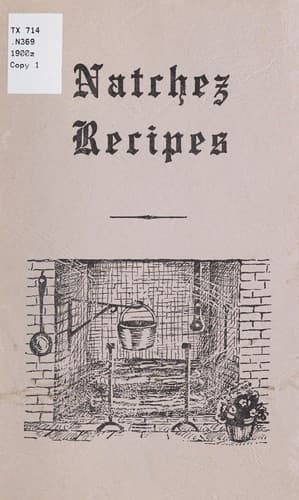
Natchez recipes
190028 readable pages · 170 recipe records · community household cookbook
From the librarian's dossier · AI-generated, grounded in the scanned text
Natchez Recipes is a community cookbook compiled around 1900, drawing together the kitchen knowledge of contributors from Natchez, Mississippi and nearby communities such as Church Hill and Arlington. Like many cookbooks of its era, it was likely assembled as a collective project, with named local contributors submitting their favorite recipes for cakes, candies, meats, soups, pickles, and more. The book moves from sweets and baked goods through entrees, seafood, and poultry, into pies, beverages, preserves, and vegetable dishes. It offers a window into Southern and Creole home cooking at the turn of the twentieth century, with recipes for dishes like turtle soup, chicken gumbo, and various pralines and fudges sitting alongside more everyday fare such as corn fritters and potato souffle. With 170 anchored food records across just three sections, this is a dense, recipe-packed volume rather than a book of essays or long narrative passages. Modern readers will find it a useful primary source for regional foodways, contributor culture in early cookbook publishing, and the ingredient preferences and cooking techniques of the period, though it assumes a cook's baseline knowledge that a modern kitchen novice may need to supplement.
The book is organized into three mechanically gated sections that together move through a fairly conventional sequence for a period community cookbook. Section 1 (pages 2-11) opens with cakes and candy, covering layer cakes, sponge cakes, specialty cakes, and confections like divinity fudge and pecan pralines. Section 2 (pages 12-21) continues with cookies before shifting into puddings, molded desserts, shellfish, meats, poultry, and pies, with headings such as Hebrew Cookies, Almond Tarts, and Cheese Souffle marking the transition points. Section 3 (pages 22-29) rounds out the collection with more pies, punches and wines, an extensive run of pickles and relishes, salad dressings, soups, and vegetable dishes. Headings throughout name specific dishes rather than broad categories, suggesting the book is organized as a running list of contributed recipes grouped loosely by course or type rather than a strict formal index.
Recipes from this book
170 records extracted from the text, showing the first 50 in reading order. Each links to a modern interpretation.
Read the book
28 readable pages. A dot marks pages with recipe records.