
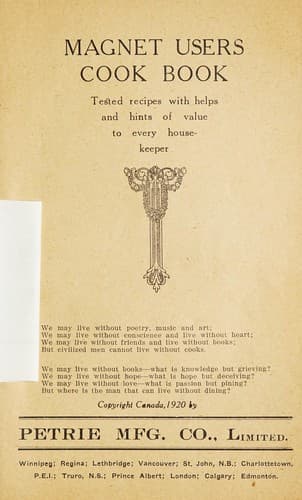
Magnet users cook book
1920Petrie Manufacturing Co · 84 readable pages · 542 recipe records · general household cookbook with promotional trade content
From the librarian's dossier · AI-generated, grounded in the scanned text
The Magnet Users Cook Book is a 1920 ninth-edition promotional cookbook published by Petrie Manufacturing Company, makers of Magnet cream separators and gasoline engines. Framed as a collection of tested recipes contributed by ordinary users, it covers the full range of early twentieth century household cookery, from soups, fish, and meats through pastries, cakes, preserves, and candies, ending with an extensive household guide built around the many uses of salt. Canadian subject headings and contributor references throughout point to a primarily rural Canadian audience. The book blends practical culinary instruction with commercial testimonials for Magnet dairy and farm equipment, making it as much a piece of period advertising as a kitchen reference. Modern readers will find it a rich window into home economics of its era, with attention to economical, practical cooking, proper equipment, and level measurements. Alongside its hundreds of food recipes, it includes a small number of household and medicinal entries, reflecting the era's blurred lines between cookery, home remedy, and domestic management. The tone is instructional and folksy, at times narrated through a recurring character, Aunt Samanthy, who dispenses household wisdom. Overall it functions as a general household cookbook wrapped around a sustained sales pitch.
The book proceeds from foundational material (cooking terms, weights and measures, and food combinations in section 1) through a logical sequence of course-based sections: soups and fish, salads and meats, poultry and vegetables, pastries and puddings, frozen desserts, cheese and eggs, breads, and an extended run of cake, cookie, and confectionery recipes spanning sections 4 through 6. Later sections shift toward economy and preservation, covering left-overs, sandwiches, invalid cookery, marmalades and jellies, drying, pickling, and candy-making in sections 7 and 8. The book closes with a household guide centered on the many uses of salt, covering cooking, cleaning, laundry, gardening, and home remedies, followed by an index in section 9. Throughout, recipe content is interspersed with testimonials for Magnet cream separators and gasoline engines, which appear as recurring headings within otherwise recipe-focused sections.
Recipes from this book
542 records extracted from the text, showing the first 50 in reading order. Each links to a modern interpretation.
Read the book
84 readable pages. A dot marks pages with recipe records.