
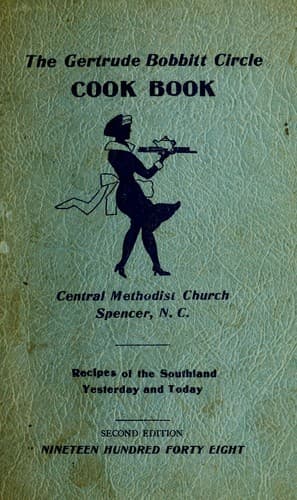
The Gertrude Bobbitt Circle cook book
1948Central Methodist Church (Spencer, N.C.). Gertrude Bobbitt Circle · 73 readable pages · 460 recipe records · community church fundraising cookbook
From the librarian's dossier · AI-generated, grounded in the scanned text
The Gertrude Bobbitt Circle Cook Book is a 1948 community fundraising cookbook compiled by the Gertrude Bobbitt Circle of Central Methodist Church in Spencer, North Carolina, and dedicated to mothers. It gathers roughly 460 anchored recipes contributed by named church members, reflecting mid-twentieth-century Southern home cooking. The book moves through beverages, breads, cakes and cookies, candies, eggs and cheese, desserts, preserves and pickles, meats, pies and pastries, salads and dressings, and vegetables, closing with poems, a humorous essay, and local business advertisements. Many recipes are scaled for large gatherings such as church suppers, and several are described as old family recipes handed down through generations, including one dated to 1900. Techniques emphasize hand methods like beating egg whites and kneading dough, along with careful attention to oven temperatures and stovetop timing typical of home kitchens of the period. Alongside practical recipes, the book weaves in devotional and sentimental material, including a Kitchen Prayer and verses on domestic life, making it as much a community keepsake as a working cookbook. For today's reader it offers a window into Southern churchwomen's culinary culture at mid-century, including regional specialties, era-specific convenience ingredients, and the commercial life of a small Piedmont North Carolina town.
The book is organized into broad culinary categories that unfold across eight sections: beverages, breads, cakes and cookies (spanning three sections with extensive layer cakes, pound cakes, fruit cakes, and frostings), candy and confections, eggs and cheese, desserts and frozen sweets, jams and pickles, meats, pies and pastries, salads and dressings, vegetables, and a closing miscellany of poems, humor, and advertisements. Section headings within the cake chapters name individual recipes directly, such as Lady Baltimore Cake and its frosting, suggesting a dense, recipe-by-recipe layout rather than long narrative prose. Decorative section headers with period poems mark transitions, such as the Pies and Pastries heading and the Kitchen Prayer before the salads section. The final section shifts from recipes to inspirational verse, a comedic essay, and pages of local business advertisements from Spencer and Salisbury, North Carolina, a common feature of church and club fundraising cookbooks.
Recipes from this book
460 records extracted from the text, showing the first 50 in reading order. Each links to a modern interpretation.
Read the book
73 readable pages. A dot marks pages with recipe records.