
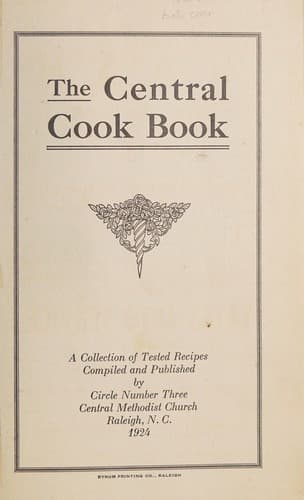
The Central cook book
1924N.C.). Circle Number Three Central Methodist Church (Raleigh · 67 readable pages · 435 recipe records · community church fundraiser cookbook
From the librarian's dossier · AI-generated, grounded in the scanned text
The Central Cook Book is a 1924 community cookbook compiled by Circle Number Three of Central Methodist Church in Raleigh, North Carolina. Like many church fundraiser cookbooks of its era, it gathers recipes contributed by named congregation members alongside period advertisements from local Raleigh businesses and national food brands such as Swan's Down Cake Flour, Knox Gelatine, Rumford Baking Powder, and Bee Brand Vanilla. Spanning soups, fish, eggs, poultry, meats, vegetables, salads, cheese dishes, cakes, breads, cookies, preserves, pickles, sandwiches, candy, beverages, and invalid cookery, the book offers a broad window into the everyday domestic kitchen of a middle-class Southern household in the early twentieth century. It contains 435 anchored food records, reflecting the scale and variety of its recipe content. Beyond recipes, the book includes practical instructional material such as cake-making hints, guidance on measuring and mixing, oven temperature tables, and household hints for cooking meats and vegetables. Modern readers will find it a useful artifact of regional foodways, church fundraising traditions, and the commercial food culture that supported home cooking in the 1920s, presented through the voices and contributions of a specific community of women.
The cookbook is organized into thematic sections that progress from savory to sweet and then to household matters. It opens with soups and fish, moves into egg dishes, poultry and meats, then vegetables, salads, and cheese dishes. A large portion of the book is devoted to cakes, fillings, icings, and related baking instruction, including cake-making hints, correct oven heat, and sections on cookies, doughnuts, muffins, and waffles. Later sections cover frozen desserts, preserves, pickles, sandwiches, and an extensive candy collection, followed by beverages, recipes for the sick, and a closing set of household hints with cooking time tables. Named headings within the summaries (such as SOUPS, CAKES FILLINGS AND ICINGS, PRESERVES, PICKLES, SANDWICHES, CANDY, BEVERAGES, RECIPES FOR THE SICK, and HOUSEHOLD HINTS) indicate a fairly conventional but detailed arrangement for a community cookbook of this period. Advertisements are interspersed throughout rather than segregated, appearing alongside recipes in nearly every section.
Recipes from this book
435 records extracted from the text, showing the first 50 in reading order. Each links to a modern interpretation.
Read the book
67 readable pages. A dot marks pages with recipe records.