
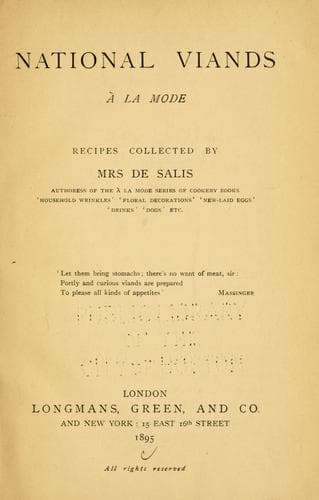
National viands à la mode
1895Harriet Anne de Salis · 42 readable pages · 158 recipe records · international regional cookbook
From the librarian's dossier · AI-generated, grounded in the scanned text
National Viands à la Mode (1895) is a late-Victorian compendium of international recipes compiled by Harriet Anne de Salis, an English cookery writer known for her thematic recipe collections. Rather than organizing dishes by course or ingredient, this book arranges them by nation and region, offering English-speaking home cooks a tour through African, American, Mexican, French provincial, German, Italian, Greek, Oriental, Russian, Polish, Siberian, and West Indian cuisines. The recipes range from hearty stews and chowders to delicate pastries and candies, reflecting the culinary curiosity and colonial-era cosmopolitanism of the period. Readers will find dishes like chutnies, tamales, macaroni, risotto, curries, and pepperpot stew sitting side by side, each presented with period-appropriate ingredient lists and technique descriptions. The book closes with a substantial alphabetical index, allowing readers to locate specific recipes across its wide geographic scope. As a historical document, it offers a window into how one Victorian author imagined and packaged the foodways of dozens of cultures for a domestic audience. Modern readers should approach it as both a cooking manual and a cultural artifact, valuable for understanding period tastes, trade networks, and assumptions about foreign cuisines, though not necessarily as an authoritative source on any single tradition's authentic practice.
The book is organized geographically into regional and national cookery sections rather than by course or ingredient type. Section 1 opens with African, American, Canadian, South American, Mexican, and French provincial dishes. Section 2 continues with German, Italian, and Greek cookery. Section 3 covers Italian dishes further, then moves into Oriental (East Indian, Arabian, Chinese, Persian) cookery, followed by Russian, Polish, and Siberian preparations. Section 5 concludes the recipe portion with West Indian dishes before transitioning into a comprehensive alphabetical index running from Agraz to Zuppa alla Romana, which references page numbers for locating specific recipes throughout the volume.
Recipes from this book
158 records extracted from the text, showing the first 50 in reading order. Each links to a modern interpretation.
Read the book
42 readable pages. A dot marks pages with recipe records.