
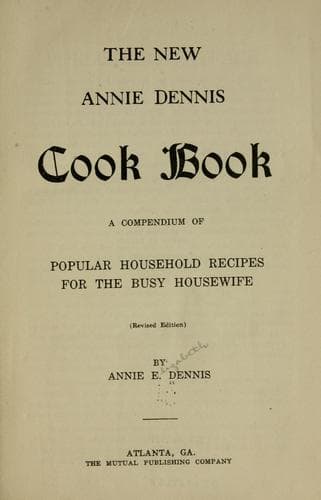
The new Annie Dennis cook book
1905Annie E. Dennis · 206 readable pages · 1,020 recipe records · Southern American household cookbook
From the librarian's dossier · AI-generated, grounded in the scanned text
The New Annie Dennis Cook Book (1905) is a substantial Southern American household cookbook compiled by Annie E. Dennis, a Georgia housewife whose culinary reputation, according to the publisher's preface, was built on winning nearly ten thousand dollars in state fair premiums. The book contains over a thousand anchored food records alongside a small handful of medicinal entries, reflecting the broad scope typical of era cookbooks that combined recipes with household and health advice. Readers will find extensive coverage of canning and preserving, breads and yeasts, soups, fish and shellfish, meats, poultry and game, sauces, salads, vegetables, cakes, puddings, ice creams, candies, chafing dish cookery, and barbecue, followed by home remedies, beauty preparations, and seasonal menus. The recipes assume a well-equipped Southern kitchen with access to fresh produce, game, and cured meats, and they document techniques such as sugar-curing hams, sun-drying figs, and fermenting scuppernong wine that were common household practices of the period but are rarely performed domestically today. This is a document of turn-of-the-century domestic science as practiced in the American South, useful to modern readers as both a culinary reference and a window into the daily rhythms, entertaining conventions, and self-sufficiency of an early 1900s household.
The book proceeds through a long sequence of food-preparation categories rather than a single rigid outline: preserving and canning open the volume (sections 1 to 3), followed by pickles and yeast breads (section 4), quick breads and griddle cakes (sections 5 to 6), soups and fish (sections 6 to 7), meats and poultry (sections 8 to 9), sandwiches, croquettes and sauces (section 10), salads and eggs (section 11), vegetables (sections 12 to 13), an extended run of cakes (sections 13 to 14), and then desserts including ice creams, puddings, pies, and custards (sections 15 to 16). Later sections cover beverages and light lunch dishes (sections 17 to 18), chafing dish cookery, candies, and barbecue (section 19), before the book shifts into home remedies, beauty preparations, and seasonal menus (section 20), closing with a detailed alphabetical index (section 21) that lets readers locate recipes by category across the whole volume.
Recipes from this book
1,018 records extracted from the text, showing the first 50 in reading order. Each links to a modern interpretation.
Read the book
206 readable pages. A dot marks pages with recipe records.