
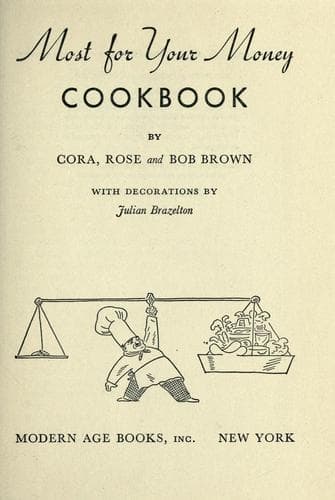
Most for your money cookbook
1938Cora Lovisa Brackett Brown, Cora Brown · 129 readable pages · 256 recipe records · economical household cookbook with social commentary
From the librarian's dossier · AI-generated, grounded in the scanned text
Most for Your Money Cookbook (1938) by Cora Brown (Cora Lovisa Brackett Brown) is a Depression-era guide to economical American cooking that blends practical recipes with social commentary on food waste, marketing deception, and class disparities in diet. Drawing on the author's experience cooking across Europe, the book champions frugal ingenuity: turning vegetable cooking water into broth, transforming underused cuts like hearts, kidneys, cheeks, and trotters into refined dishes, and embracing overlooked seafood such as mussels and octopus. The text ranges widely across soups, shellfish, fish, meats, one-dish stews, barbecue, breads, sandwiches, vegetables, fruits, candies, and desserts, all filtered through a lens of thrift and resourcefulness. Interspersed with recipes are consumer advocacy passages on grocery scales, market reports, and produce selection, plus a closing historical essay questioning how the poor have been fed throughout history. Readers will find international influences (French, Spanish, Polish, Mexican, Italian, Hungarian) alongside American regional traditions, particularly Southern and African American pork cookery. The book functions as both a cookbook and a piece of social criticism, aiming to prove that economy need not mean deprivation. It closes with an index and a publisher's catalog of contemporaneous titles, anchoring it firmly in its 1938 publishing context.
The book is organized into numbered chapters (roman numerals visible in headings, such as I. Substantial Soup, VI. Snacks, VII. Savory Spreads, XII. Dishes for Knife, Fork and Spoon, XXIII. The Pick of the Pushcart, XXIV. Fruity Desserts, and XXIX. We Dine for the Poor) that move from soups and shellfish through meats, one-dish meals, barbecue, breads, sandwiches, vegetable and fruit buying guides, candy and cake making, and finally a polemical historical chapter. Section 13 closes with an index and a publisher's catalog of other 1938 titles. Several sections combine recipes with instructional or advisory prose, such as marketing advice, produce selection guides, and seasoning tips, rather than presenting recipes alone.
Recipes from this book
256 records extracted from the text, showing the first 50 in reading order. Each links to a modern interpretation.
Read the book
129 readable pages. A dot marks pages with recipe records.