
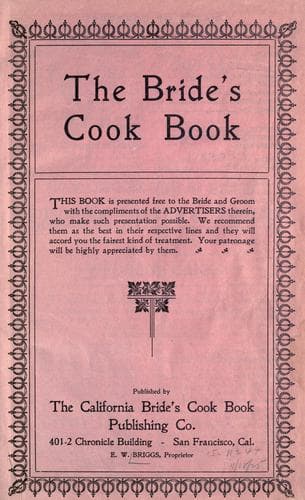
The bride's cook book
1915Edgar William Briggs · 138 readable pages · 618 recipe records · general household cookbook with embedded wartime conservation guidance and commercial advertising
From the librarian's dossier · AI-generated, grounded in the scanned text
The Bride's Cook Book (1915) is a promotional household cookbook credited to Edgar William Briggs and distributed as a gift by San Francisco merchants to newlyweds. It combines standard early twentieth century American cookery with a distinctly commercial and wartime character: sections carry advertisements for furniture stores, phonographs, cameras, and photography studios, alongside a substantial embedded advertising booklet from Del Monte promoting canned fruits and vegetables. The book also carries a federal Food Administration approval letter and incorporates official wheat and sugar conservation guidance, reflecting its production during a period of food rationing. Content ranges widely across housekeeping and stain removal, wartime substitute breads made from barley, corn, rice, and oats, an extensive run of desserts, meats, game, poultry, fish and shellfish, soups and stocks, sauces, pickles and preserves, canning and jelly-making, candies, beverages, and a large closing block of Del Monte brand recipes for canned produce. With 618 anchored food records, it functions as both a practical kitchen reference and an artifact of commercial and governmental food messaging during the First World War era. Modern readers will find it a rich source for understanding how domestic advice, patriotic rationing appeals, and brand advertising were woven together in a single household volume.
The book opens with front matter, housekeeping and cleaning advice, and Food Administration rationing guidance (section 1), then moves into measuring, menu planning, and wartime substitute breads (sections 2 and 3). Desserts, custards, puddings, and frozen dishes occupy a long stretch (sections 4 and 5), followed by poultry, game, oysters, and salads (section 6), meat stocks and soups (section 7), and further meat, game, and meat-substitute cookery (sections 8). Sauces, pickles, preserves, and vegetable cookery follow (section 9), then canning, jelly-making, and beverages (section 10). The final third of the book (sections 11 through 14) is dominated by a lengthy embedded Del Monte advertising booklet organized by canned product, moving fruit by fruit and vegetable by vegetable (cherries, peaches, pears, pineapple, plums, prunes, asparagus, chile peppers, peas, pimientos, pumpkin, squash, spinach, string beans, tomatoes, olives, raisins), each with serving suggestions and recipes, closing with a map of packing locations and further advertisements.
Recipes from this book
617 records extracted from the text, showing the first 50 in reading order. Each links to a modern interpretation.
Read the book
138 readable pages. A dot marks pages with recipe records.