
The Pocumtuc Housewife, a Guide to Domestic Cookery as it is Practised in ...
1906[name missing] · 22 readable pages · 114 recipe records · general household and domestic cookbook
From the librarian's dossier · AI-generated, grounded in the scanned text
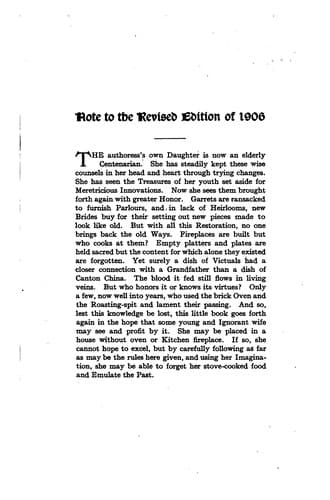
The Pocumtuc Housewife is a domestic guide rooted in the farm households of the Connecticut Valley, first published in 1805 and reissued in a revised 1906 edition. It presents itself as a practical manual for feeding large farming households across the seasons, covering meats, boiled dinners, chowders, breads, and pies alongside cakes, preserves, pickles, and home remedies. Beyond cookery, it extends into the wider domestic sphere: soap-making, candle-making, laundry care, dyeing fabrics, and treating common ailments with household ingredients. The 1906 edition appears to have been produced as a fundraiser tied to Deerfield Academy and the First Church, with a closing directory of local Deerfield and Greenfield businesses and craft industries. For today's reader it offers a window into how a rural New England household of the nineteenth and early twentieth centuries organized food, health, and home labor together in a single reference work. The book blends recipe instruction with era-specific medical advice and household arts, reflecting a period when cookbooks often served as general domestic manuals rather than narrowly focused culinary texts. Its regional identity, tied to the Pocumtuc name and Deerfield's colonial revival crafts, gives it a distinct local character among cookbooks of its time.
The book moves from an introductory section establishing its purpose and audience, through core cookery covering meats, boiled dinners, breads, and pies, into a second section devoted to cakes, custards, preserves, pickles, and a substantial medical section called The Physical Director, followed by household arts like soap and candle-making. A short final section covers fabric dyeing techniques before closing with advertisements and a directory of Deerfield industries, reflecting the book's role as an institutional fundraiser.
Recipes from this book
114 records extracted from the text, showing the first 50 in reading order. Each links to a modern interpretation.
Read the book
22 readable pages. A dot marks pages with recipe records.