
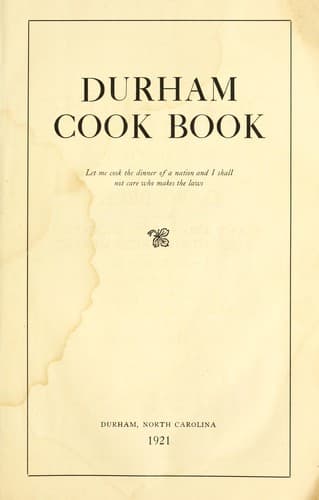
Durham cook book ...
1921Durham (N. C.) Trinity Methodist Church. Woman's Missionary Society · 78 readable pages · 440 recipe records · community fundraising cookbook
From the librarian's dossier · AI-generated, grounded in the scanned text
The Durham Cook Book is a 1921 community fundraising cookbook compiled by Circle No. 2 of the Woman's Missionary Society of Trinity Methodist Church in Durham, North Carolina. It gathers roughly 440 recipes contributed by local church members alongside advertisements from Durham businesses, reflecting a common practice of the era in which congregational groups produced cookbooks to raise money while documenting the everyday and celebratory cooking of their community. The book moves through the full arc of a household's culinary needs, from meats, soups, and vegetables through an especially extensive run of cakes, candies, and pies, into breads, salads, seafood, sandwiches, beverages, pickling, canning, and finally invalid cookery and household hints. Recipes are largely attributed to named contributors, giving the collection a personal, communal voice rather than that of a single professional author. Readers will find period brand names such as Royal Baking Powder, Crisco, Snowdrift, Fleischmann's Yeast, and Knox Gelatine woven throughout, situating the book firmly within early twentieth-century American commercial food culture. Alongside recipes for everyday dishes and elaborate company desserts, the book includes practical guidance on menu planning, food combinations, canning and preserving, and home remedies, making it a rich artifact of domestic life, church fundraising culture, and regional Southern cooking in the early 1920s.
The book opens with advertisements, a table of contents, and introductory material on food combinations, sample menus, and measurement equivalents before launching into the recipe sections proper (section 1). Recipes are organized by category in a fairly traditional sequence: vegetables and meats, then soups, then an unusually large cluster of cakes spanning several sections (sections 1 through 3), followed by small cakes, cookies, and candies (sections 3 and 4). Bread recipes and the start of cheese and egg dishes follow (section 4), then cheese, fish and oysters, salads, and pies (section 5), an extended run of pie fillings, custards, and frozen desserts (section 6), and a final stretch covering puddings, sauces, sandwiches, pickles, beverages, and canning (section 7). The book closes with more preserving instructions, recipes for the sick, and household hints (section 8). Throughout, headings mark clear category shifts, and many recipes carry the names of individual contributors, underscoring the book's identity as a compiled community project rather than a single authored text.
Recipes from this book
440 records extracted from the text, showing the first 50 in reading order. Each links to a modern interpretation.
Read the book
78 readable pages. A dot marks pages with recipe records.