
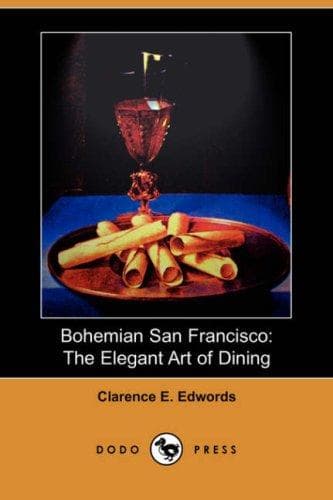
Bohemian San Francisco
1914Clarence E. Edwords · 72 readable pages · 61 recipe records · restaurant guide and cookbook memoir
From the librarian's dossier · AI-generated, grounded in the scanned text
Bohemian San Francisco (1914) by Clarence E. Edwords is part memoir, part restaurant guide, and part cookbook, celebrating the cosmopolitan dining culture of early twentieth century San Francisco. Rather than a conventional recipe collection, it is structured as a tour through the city's eating houses, from Gold Rush era establishments through the aftermath of the 1906 fire, weaving history, character sketches, and neighborhood color together with recipes attributed to specific restaurants and chefs. Edwords presents San Francisco as a unique meeting point of Spanish, Italian, French, Mexican, Chinese, Japanese, and German culinary traditions, and frames Bohemianism itself as a state of mind rooted in appreciation for good food, good company, and cosmopolitan living rather than mere eccentricity. Readers encounter descriptions of famous venues like the Cliff House, the Palace Hotel, Coppa's, and the markets of Fishermen's Wharf, alongside recipes for dishes served there, such as oyster omelets, planked fillet mignon, and various shellfish preparations. The book closes with practical notes on tipping, wine service, and indices for locating recipes and restaurants. For modern readers, it offers a vivid, opinionated snapshot of a lost dining world, valuable as much for its social history as for its kitchen instructions.
The book proceeds roughly chronologically and geographically. It opens with a foreword and historical overview of San Francisco dining from Spanish colonial days through the Gold Rush (section 1), then surveys specific restaurants and neighborhoods in turn: pre and post fire establishments (section 2), Chinatown, Japanese dining, the Palace Hotel and Hotel St. Francis, and Little Italy (section 4), Fishermen's Wharf and seafood culture (section 5), shellfish cookery and comparative dining costs (section 6), the Latin Quarter with wine and tipping guidance (section 7), and a closing set of dessert and beverage recipes followed by indices of recipes and restaurants (section 8). Recipes are embedded within the narrative descriptions of restaurants and neighborhoods rather than grouped by course or ingredient, so the organization follows the author's tour of the city rather than standard cookbook conventions.
Recipes from this book
61 records extracted from the text, showing the first 50 in reading order. Each links to a modern interpretation.
Read the book
72 readable pages. A dot marks pages with recipe records.