
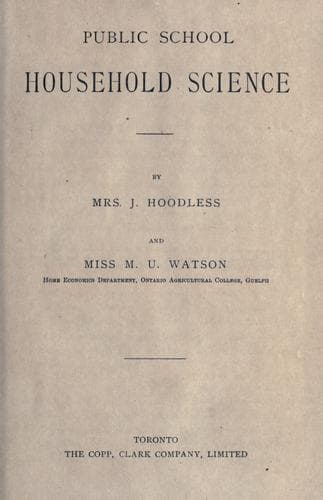
Public school household science
1905Adelaide Hoodless · 70 readable pages · 135 recipe records · household science textbook
From the librarian's dossier · AI-generated, grounded in the scanned text
Published in 1905 by Adelaide Hoodless, Public School Household Science is a Canadian textbook designed to teach domestic science to public school pupils. It blends elementary nutritional science, being an explanation of proteins, carbohydrates, fats, minerals, and water, with practical instruction in cooking methods, kitchen equipment, and household management. The book moves from the scientific rationale for food and cooking through step-by-step recipes for fruits, vegetables, cereals, eggs, dairy, meats, soups, and baked goods, before turning to broader domestic subjects such as laundry, stain removal, home sanitation, table service, marketing, and basic first aid. A recurring emphasis is placed on economy and practicality, noting that cheaper cuts of meat can be as nutritious as costly ones when properly prepared, and that recipes should be adaptable for either home or schoolroom use under teacher supervision. Later sections address the care of invalids, with specialized therapeutic recipes and dietary advice for the sick and convalescent. Throughout, the text functions less as a cookbook for entertainment and more as a structured curriculum meant to instill scientific and moral discipline around housework, cooking, and hygiene. Modern readers will find it a revealing window into early twentieth-century educational philosophy, gender expectations, and domestic ideals as they were formally taught to schoolchildren in Canada at the turn of the century.
The book is organized as a sequential textbook rather than an alphabetical reference. It opens with front matter and an introductory chapter on the home, followed by chapters on food constituents, cooking methods and equipment (section 1). It then proceeds through beverages, fruits, vegetables, cereals, eggs, milk, and cheese (section 2), before addressing more complex prepared dishes, preserving, marketing, food storage, and meal planning for workers and invalids (section 5). Later chapters shift toward domestic management: home organization by room, daily cleaning routines, and laundry (section 6), concluding with stain removal, sanitation, first aid, and extensive nutritional reference tables (section 7). The numbered chapter and section headings suggest a classroom curriculum structure, moving from scientific principles to increasingly practical and managerial household skills.
Recipes from this book
135 records extracted from the text, showing the first 50 in reading order. Each links to a modern interpretation.
Read the book
70 readable pages. A dot marks pages with recipe records.