
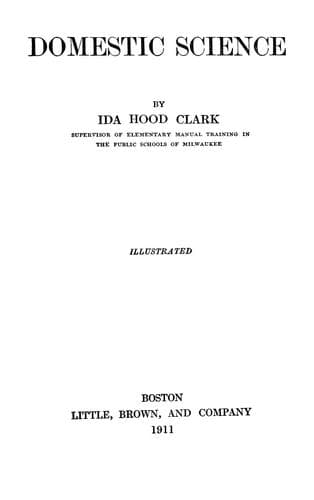
Domestic science (Clark, Cornell home economics)
1911Ida Hood Clark · 116 readable pages · 142 recipe records · domestic science textbook with recipes
From the librarian's dossier · AI-generated, grounded in the scanned text
Domestic Science is a 1911 classroom textbook by Ida Hood Clark, written for teaching cooking and home economics to students in elementary and secondary schools. Rather than a simple recipe collection, it is organized as a series of numbered lessons that pair kitchen practice with scientific explanation, covering topics from starch chemistry and egg albumen to bacteria in milk and the botany of tea and cacao. Each lesson typically offers both a home recipe and a school recipe, reflecting its dual purpose as a guide for household cooks and a curriculum for laboratory-style classroom instruction. Alongside cooking techniques, the book addresses kitchen management topics such as stove combustion, fireless cookers, table service, and waitressing duties, situating cookery within a broader program of domestic training. Readers will find discussions of food composition and digestibility interwoven with practical instructions for dishes like griddle cakes, ice cream, doughnuts, and canned fruit. The text's scientific framing, with references to physiology, chemistry, and even geography and history of foodstuffs, marks it as part of an educational movement to professionalize and rationalize home cooking. Modern readers approaching this book should expect an instructional tone directed at student cooks working in pairs, with an emphasis on measurement, technique, and underlying food science rather than narrative or personal commentary.
The book is arranged as a sequence of numbered lessons, each tied to a specific food, technique, or kitchen science topic. Sections progress from foundational cooking principles and basic starches (potatoes, cereals, macaroni) through proteins (eggs, fish, meat), dairy and vegetables, cereals and baking, fruits and fats, frozen desserts and bread, tea and dining service, preservation and jelly-making, combustion and fire management, sandwiches and chocolate, and finally poultry, fried foods, and the fireless cooker. Many lessons follow a consistent internal structure: an explanation of composition or science, an 'Order of Lesson' or classroom procedure, and both a home recipe and a corresponding school recipe. Headings such as 'Lesson XV' or 'Lesson XXXII' mark this progression, and the summaries show recurring pedagogical devices like experiments, demonstrations, and student responsibilities for classroom housekeeping tasks.
Recipes from this book
142 records extracted from the text, showing the first 50 in reading order. Each links to a modern interpretation.
Read the book
116 readable pages. A dot marks pages with recipe records.