
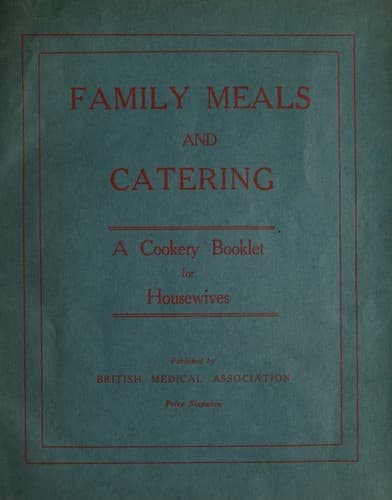
Family meals and catering
1935British Medical Association · 15 readable pages · 61 recipe records · household nutritional cookbook and menu planning guide
From the librarian's dossier · AI-generated, grounded in the scanned text
Family Meals and Catering is a 1935 practical cookbook produced by the British Medical Association, growing directly out of the 1933 B.M.A. Nutrition Committee report on affordable, nutritionally adequate diets. Rather than a general recipe collection, it is a working manual built around three weeks of dinner and high tea menus designed for a household of five, aimed at proving that wholesome, balanced meals could be prepared on a tight budget. Each week's menus are accompanied by shopping lists, standard measures, ingredient proportions, and full recipes, moving from planning through purchasing to cooking. The recipes themselves reflect traditional British working-class cookery of the period: roasts, meat pies, offal dishes, steamed puddings, soups, and preserves. Notes addressed to domestic science teachers reveal the book's didactic purpose, showing readers how to substitute ingredients while preserving nutritional value using food value tables. For the modern reader, this is less a book to browse for inspiration and more a historical document of household economy, nutrition science, and family catering practice in interwar Britain, offering a window into how one influential medical body attempted to translate nutritional research into everyday domestic practice.
The book is organized around a menu-planning framework rather than an alphabetical or course-based recipe arrangement. Section 1 opens with an introduction explaining the book's origin in the 1933 Nutrition Committee report, followed by practical notes on using the menus and recipes, a table of homely measures, and standard proportions for common dishes, before presenting Week I menus with full recipes and shopping lists. Section 2 continues into further daily menus with recipes for dinners, teas, and high teas, followed by quantity tables aggregating ingredients used across Week I and Week II, and closing notes for domestic science teachers on substituting ingredients using food value tables. The overall structure moves from explanatory front matter to week-by-week practical menus and recipes, then to summary tables for teaching and planning purposes.
Recipes from this book
61 records extracted from the text, showing the first 50 in reading order. Each links to a modern interpretation.
Read the book
15 readable pages. A dot marks pages with recipe records.